Why Does My Team Keep Missing Goals Even Though We Track KPI’s?
Data was supposed to solve the execution problem. Every system reports out numbers, and every team owns a set.
→ Sales has a dashboard and CRM.
→ Finance has treasury reports and forecasts.
→ Operations has a spreadsheet, planning log, and labor metrics.
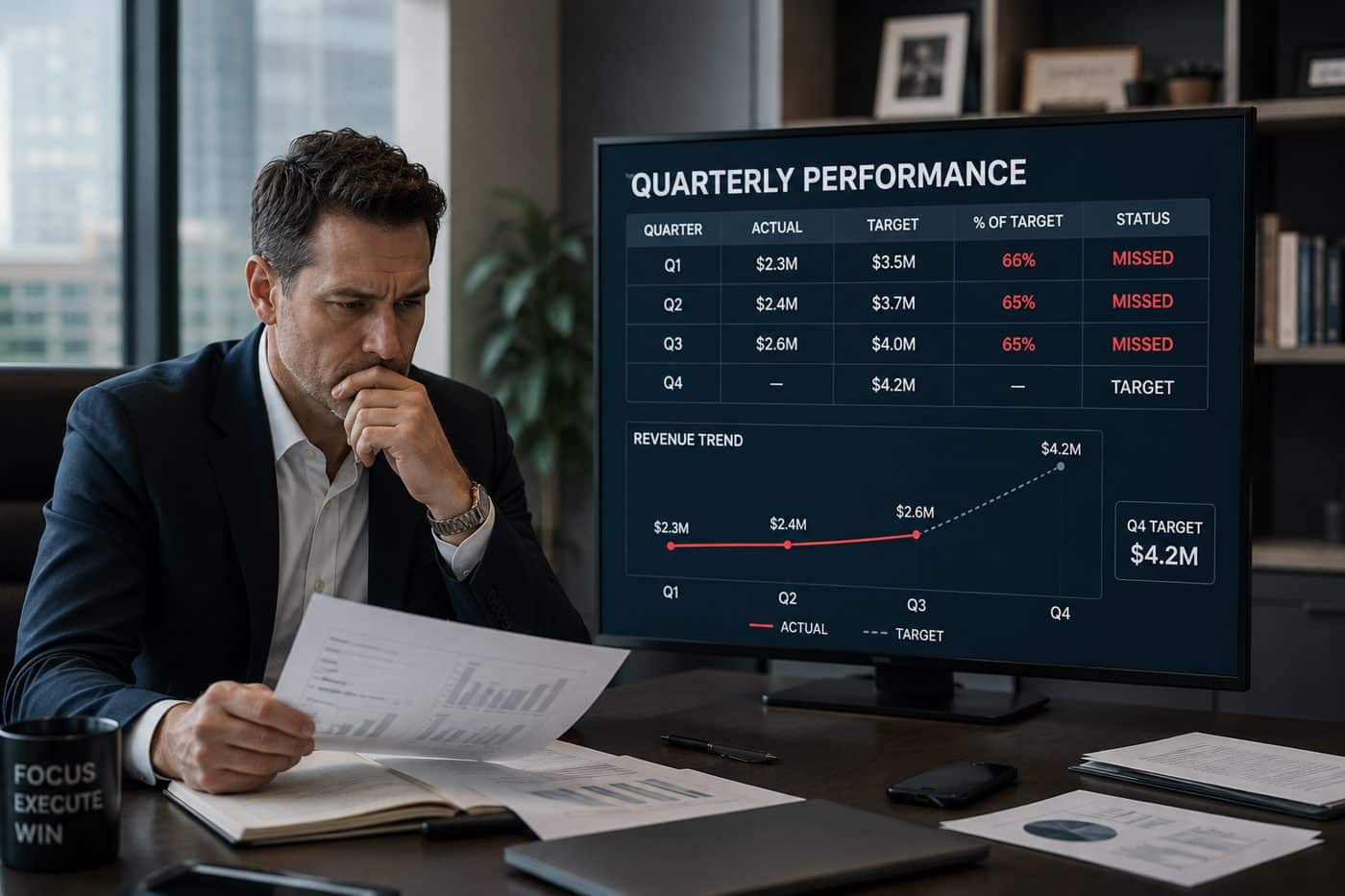
And yet quarter after quarter, targets are missed and goal execution stalls.
This article covers three execution problems that cause teams to miss goals even when they’re measuring the right things, and the solutions that drive results rather than explanations.
Report-Building Is Replacing Decision-Making Time
You ask every department to produce a weekly update so your leadership team can work from the same information. That’s the right instinct. A shared picture of where things stand should make meetings tighter, strategic decisions faster, and course corrections easier to catch.
But here’s what actually happens.
Each department lead pulls numbers from their own system, reformats them into a slide or summary, and sends the update or enters it into a shared doc right before the meeting. The process happens in sales. In finance. In operations. Often all within the same couple of hours.
By the time the meeting starts, the team has spent hours just answering the question: “Where do things stand?“
Those hours don’t go toward figuring out what to do next.
The data also arrives stale. Your sales lead’s numbers from Tuesday’s pull are already outdated by Thursday’s meeting. The operations update was accurate when it was pulled, but two decisions happened since. Most growing companies tolerate a day-long gap between when data is generated and when it reaches the people who need to act on it. Some tolerate weeks. That gap is where execution slips.
What fixes this? Direct Integrations.
Align connects to the tools your team already uses — Excel, Google Sheets, Asana, Microsoft To-Do, Microsoft Planner, and dozens more. When a metric updates in the source system, it automatically ripples across the company view in Align. No manual transfer. No reformatting. No stale slide from last Tuesday. The scoreboard reflects the work as it happens, and your team walks into every meeting with the same live picture without anyone spending hours producing it.
Why Your Team Misses Goals They Can See Coming
You set quarterly targets to keep the team focused on the right outcomes over a sustained period. Quarterly goals create a long enough runway to build momentum. They’re meaningful enough to hold attention. They’re the right unit of work for a leadership team trying to move a business forward.
But a quarter is also long enough to drift without anyone noticing.
We’ve all been through this scenario. A goal goes off pace in weeks two or three. The month closes, you pull the numbers, and in your monthly review you see the shortfall. The team gets realigned on what needs to happen: adjust the approach, focus on the right activities, and push harder over the next four weeks. It feels like there’s a clear plan.
Then the second month starts.
Two weeks in, the goal drifts again, following the same pattern — gradual, no obvious red flag. But you won’t see it until after the second month closes. Now you’re in week ten of the quarter, and the math doesn’t work in your favor. You’re looking at trying to make up 60 to 70 percent of the remaining gap with three weeks left.
When you’re weeks into a quarter with no live visibility into where metrics are tracking, there’s no early signal that a goal is falling behind.
Gallup’s research on employee engagement consistently shows that teams who receive frequent, visible progress updates perform at higher levels than those operating on periodic review cycles. A quarterly debrief is a periodic review cycle. A live metric that flags a shortfall is the frequent, visible signal that actually moves performance.
What fixes this? KPI Cards, Projection Lines, and Gap Calculations.
Each KPI in Align gets its own card that clearly displays current performance, the target, and the gap to target. Your team knows exactly how far off they are, not just whether they’re “behind.” The quarter-long graph shows the week-over-week trend, so a leader can see whether the metric is gaining or losing ground. And the projection line does the most useful thing of all: it shows where the metric will land by the end of the quarter at the current pace, before the quarter ends.
Here’s what that changes in practice:
- Your sales leader sees that, in week six, the pipeline metric will be 74% of target at the current pace — with seven weeks left to adjust.
- Your ops leader sees that a cost initiative is trending behind and flags it for the team before it becomes a miss.
- Your CEO sees the full picture in one view, without scheduling a check-in with each department to find out where things stand.
That’s the difference between managing a quarter and proactively driving progress.
When Accountability Gets Personal
You’ve bought into “when everyone is responsible, no one is” — so you assign a single owner to each goal. It’s the right call. Clear ownership is one of the few management principles with decades of research behind it, and it works.
The owner knows the goal. They manage their progress on their own, report on it at review time, and update the team when asked.
But most companies stop there.
Here’s the problem with that setup: accountability requires the belief that someone is watching. Research on felt accountability shows that people only truly feel accountable when they believe their progress will be observed and evaluated. Not just at review time, but consistently. When a goal owner is the only person who can see their own progress, that pressure disappears. Ownership is formal, but not felt.
The research goes further. A widely cited study from Dominican University of California found that participants who wrote down their goals, committed to specific actions, and sent weekly progress reports to another person achieved 33 percentage points more than those who only thought about their goals without writing them down. The difference between 43% achievement and 76% achievement wasn’t skill, strategy, or effort — it was the act of someone else seeing the progress each week.
That’s the piece most goal systems miss entirely.
When progress is disclosed in a meeting, accountability is an event. When progress is visible, accountability is continuous — it’s built into the environment the owner operates in every day.
FranklinCovey, whose research on execution spans decades of work with high-performing organizations, puts it plainly: “People play differently when they’re keeping score.” A scoreboard that everyone can see changes the behavior of the person responsible for it.
What fixes this? A shared system where goal progress is visible to the full leadership team, updated weekly, with a named owner tied to every metric.
When the whole team can see who owns what, and where each goal stands in real time, the accountability structure shifts from private to shared. The owner knows the team can see it. That single fact changes behavior without requiring a conversation, a follow-up, or a management intervention.
Progress stops being something disclosed at review time and becomes something the team holds together, every week of the quarter.
What Your Team’s Week Looks Like When This Is Working
As you can see, the three problems above don’t require you to create a new strategy or define new goals. If you’re looking to help your team turn more KPIs into results, they need a different operating environment.
Here’s what your team’s week looks like when that environment is in place:
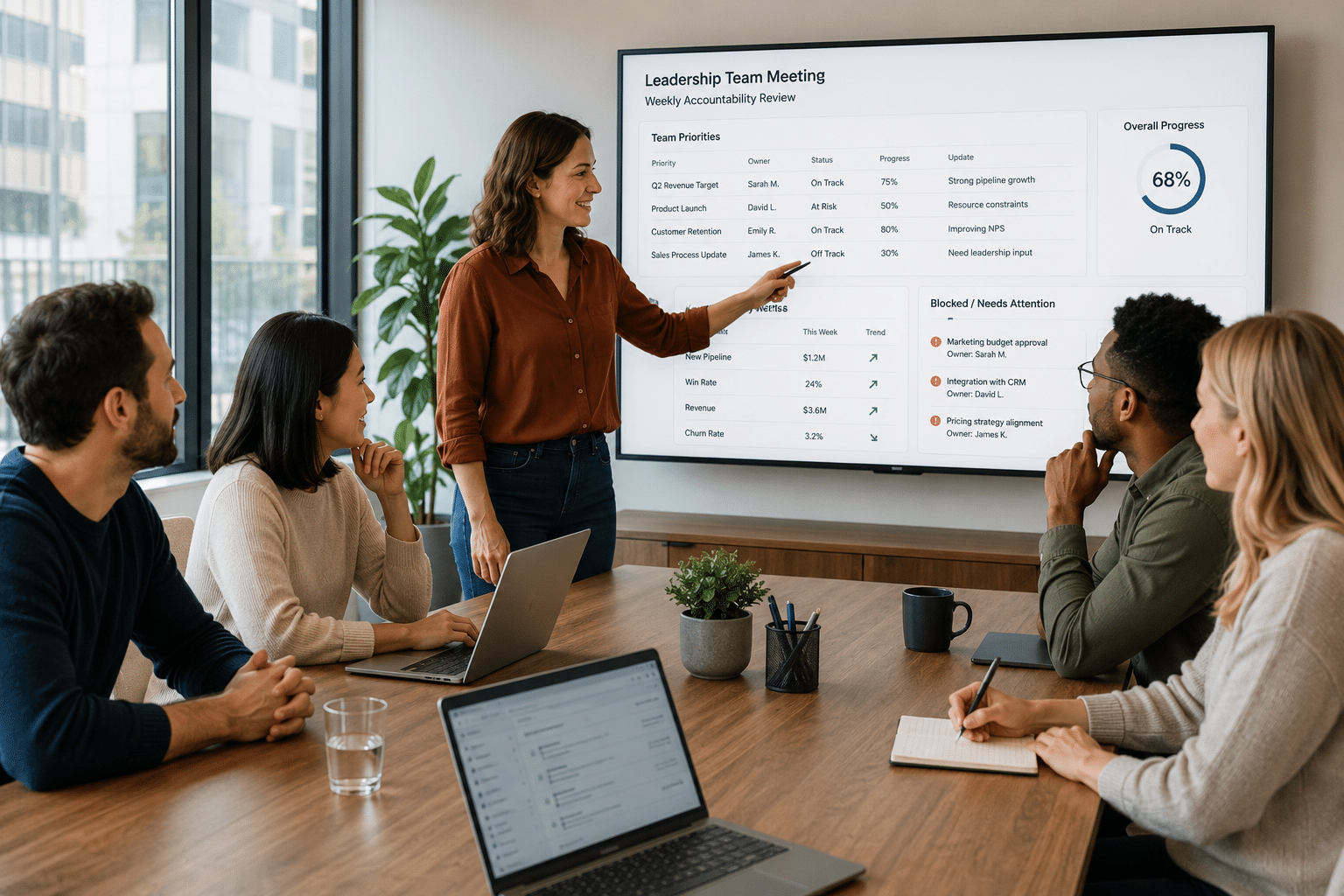
- The meeting starts with everyone already knowing where the numbers stand.
- No one spent the morning pulling reports.
- No one is presenting a slide that summarizes what happened last week.
The conversation moves straight to decisions: which metrics need attention, where to reallocate effort, what’s trending toward a miss before it becomes one.
That’s the week your team is capable of having. One where their energy is spent moving things forward toward results. To make the switch, the data your team is already tracking just needs to be live and visible so they can act on it in time to make a difference.
Tracking KPIs was never the hard part. The hard part is building a system in which those numbers reach the right people at the right time, with enough runway left to change the outcome. That’s the difference between a team that measures results and a team that gets them.
Try Insights by Align to start your environment of results →
Smart Moves Today. Big Wins Tomorrow.
Align is strategic execution software for leadership teams who want plans to turn into results. More than 2,200 companies across 64 countries use Align to build consistent execution habits, run effective weekly meetings, and keep teams accountable quarter after quarter. Learn more at aligntoday.com.