
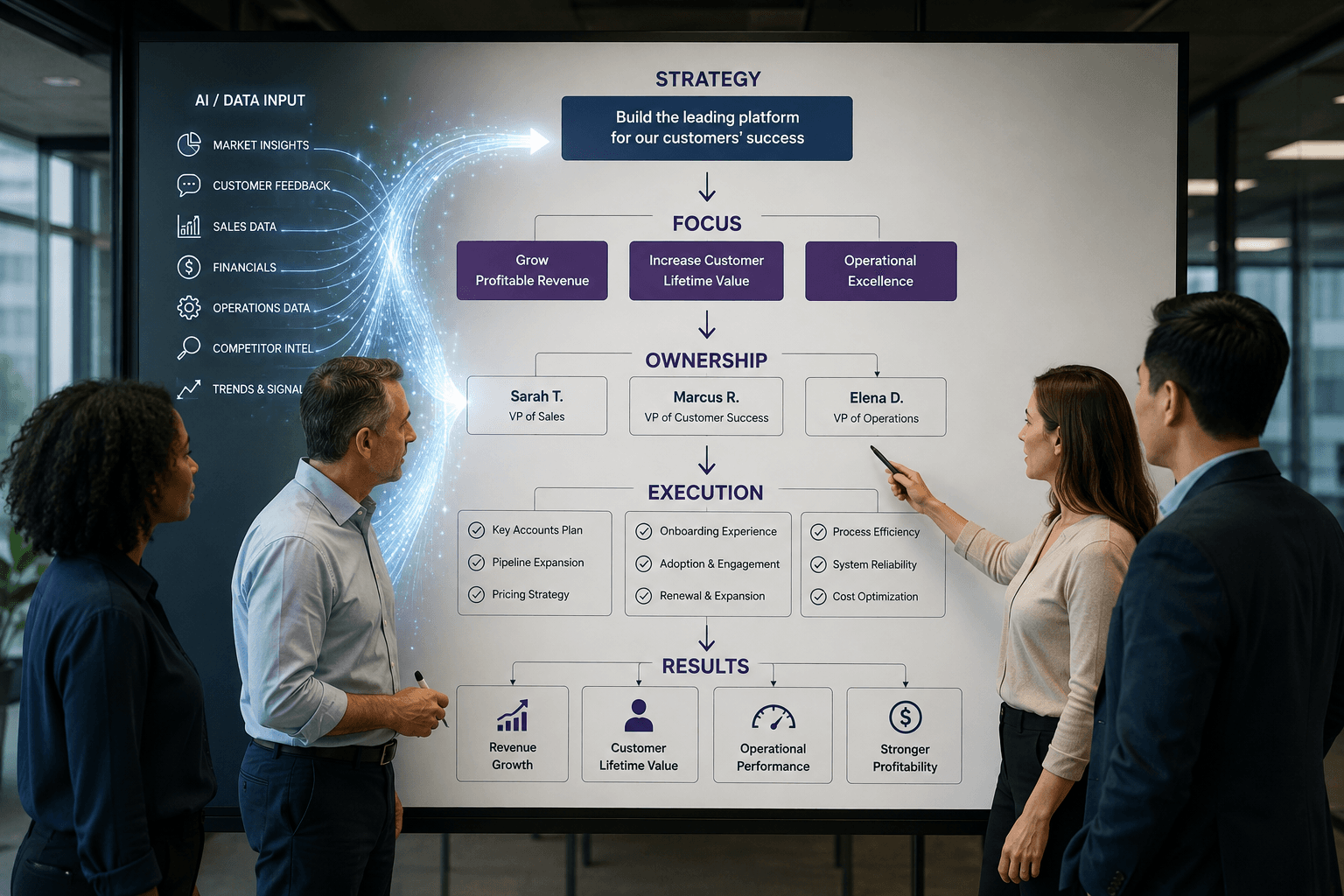
AI will not fix your operating habits. It will amplify them.
You encouraged your team to adopt AI to help them move faster.
Marketing can produce a campaign brief in an afternoon instead of three days. Sales can summarize a dozen customer conversations before the next pipeline meeting. Operations can analyze a spreadsheet in minutes. Your leadership team can turn a pile of information into a presentation before lunch.
And for a while, it feels like the company has found another gear.
Then you start noticing something strange.
There are more reports, but not necessarily better decisions. More ideas, but not necessarily more progress. More information, but not necessarily more clarity.
Your team is using AI to create faster answers to different priorities. People are producing work at a pace that would have been impossible a year ago, while some of the initiatives you said mattered most are still sitting on the list.
That is where AI gets interesting for a leadership team.
The technology isn't necessarily creating the problem. It's magnifying the way you operate.
If your company has clear priorities, clear ownership, good information, and a habit of acting on what you learn, AI can accelerate all of it. If those things are inconsistent, AI will accelerate that, too.
More Focus, Or More Chaos?
AI amplifies whatever is already true about your organization's direction. In companies with sharp, specific priorities, it speeds up the work. In companies running eleven quarterly objectives, progress is made in all eleven directions simultaneously, which sounds efficient but adds up to very little.
MIT's Media Lab found this pattern at scale in 2025. Based on 52 executive interviews, surveys of 153 leaders, and analysis of more than 300 public AI initiatives, the report found that roughly 95% of the companies studied had seen little or no measurable P&L impact from their GenAI pilots; about 5% had achieved rapid revenue acceleration. Gartner offered a related prediction: that over 40% of agentic AI projects will be scrapped by the end of 2027, citing escalating costs, a lack of risk controls, and operational chaos inside the organizations running them.
Think about what happens when a team has five different priorities competing for attention. Before AI, they might spend a few hours researching each one. Now they can spend 30 minutes producing a polished analysis of all five.
The company hasn't become more focused. If fact, it’s become more efficient at being unfocused.
That is why the most useful AI conversation for a CEO isn't just about which tools to buy or how many employees use them. It is about what AI reveals about how the company makes decisions, sets priorities, shares information, and follows through.
Here are five areas worth examining to see where AI could amplify weaknesses in your organization.
1. AI Rewards Strategic Clarity, and Exposes Every Place You Don't Have It
A CEO discusses the company's strategy at an all-company meeting. The quarterly goal is to increase revenue.
It seemed clear, but ask five people across the organization what that strategy is, and you may get five different answers.
- The leadership team knows that means you want higher retention and more expansion revenue from your most valuable accounts.
- The sales team uses AI to identify expansion opportunities. Marketing uses that information to develop a campaign aimed at new prospects.
- Customer success uses AI to create a retention program. Finance uses that report to analyze pricing.
Every team is doing something intelligent, but fragmented, so three months later, revenue hasn't moved much.
Why?
The company had a revenue goal but lacked clarity about which part of the revenue problem mattered most right now.
AI didn't create five competing priorities. It simply made it much easier for five teams to pursue them simultaneously.
This happens in smaller ways, too. A team member asks AI:
“What are the best ways to improve customer retention?”
The answer is useful. But if the company hasn't decided whether retention is actually one of its top priorities this quarter, the answer becomes another interesting piece of information competing for attention. That's the distinction between having information and having direction.
A company with strategic clarity will give AI a specific job.
“Analyze the last six months of customer data and identify the three customer segments with the highest expansion potential.”
That's a very different question from:
“What should we do to grow revenue?”
The first starts with a decision about where the company is going. AI will help determine how to advance that goal. The second asks AI to help determine the direction itself.
There is nothing wrong with using AI to explore possibilities. But once a leadership team has chosen its priorities, those priorities need to become specific enough that the rest of the organization can make decisions against them. If not, AI won't solve the problem.
More clarity will.
2. AI Accelerates Information. It Doesn't Create the Authority to Act on It.
One of the most useful things AI can do for a growing company is make information easier to understand.
It can summarize customer feedback, identify patterns in sales data, compare scenarios, pull themes from employee surveys, and turn a mountain of information into something a leadership team can digest. But then someone has to decide what happens next.
Consider a common situation.
Your sales team sees a drop in close rates and uses AI to analyze the pipeline. It identifies a pattern: deals are taking longer to move from proposal to close.
Marketing runs its own analysis and concludes that lead quality has changed. Operations looks at the same period and sees a capacity issue. Finance is concerned about discounting.
All four teams may be right.
But now you have four well-supported explanations.
AI has given everyone more information. It hasn't decided which issue the company should address first. That requires leadership, and is where unclear decision authority becomes expensive.
If nobody knows who gets to make the call, the company can spend weeks producing better analysis instead of making a decision. The problem may show up as:
“We need more data.”
“Let's look at this another way.”
“Let's get Marketing's perspective.”
“Let's run the numbers again.”
Meanwhile, the quarter keeps moving.
This isn't an AI problem. It's a leadership problem that AI makes easier to see. As companies grow, people need to know not only who contributes to a decision, but who owns the decision. The downstream impact is trust. When leadership cannot reconcile the competing analyses, a specific question surfaces across the organization: whose version do we believe?
Who decides?
Who acts?
What are they responsible for changing?
Those questions become more important as AI makes information available faster and at a lower cost.
3. AI Can Surface the Risk. It Cannot Make Anyone Own It.
AI can identify a risk. It can recommend an action. Making someone responsible for following through still falls entirely on you and your leadership structure.
Imagine your AI analysis identifies a growing problem with customer churn. It spots a pattern in support tickets, customer complaints, and renewal behavior that your team hadn't connected before. The analysis is excellent, so you bring it to the leadership meeting.
Everyone agrees.
- “That's concerning.”
- “We need to address that.”
- “Someone should dig into this.”
Then the meeting ends. Three weeks later, you're talking about the same problem.
The AI did its job. The organization didn't. This is where accountability systems matter. Not the uncomfortable version of accountability where a CEO is constantly checking whether people did what they promised. That works when a company is small and everyone is close to the work.
It gets much harder as the company grows.
Someone needs to own the outcome. That person needs to know what they're responsible for changing and when the organization expects to see movement. Without that, even excellent information will disappear up.
The goal isn't to put someone under a microscope. It's to make ownership clear enough that people can move without waiting for the CEO to push them.
4. AI Speeds Up Preparation. It Doesn't Reduce the Cost of Indecision.
There was a time when preparing a detailed market analysis took enough effort that someone eventually had to ask: “Is this worth doing?”
Now you can ask AI for the analysis before your coffee gets cold.
But it creates a new temptation: mistaking preparation for progress. A leadership team can spend an hour generating scenarios, another hour comparing options, and another hour asking AI to improve the recommendation.
And still not make the decision.
The problem is that research has a comfortable feeling to it. It looks like work. The cost shows up not just in wasted hours but in quarters that carry on without decisions.
Decisions are different. It commits resources. It creates accountability.
Organizations shortening this gap share one operational trait.
They convert information into committed action within the same conversation that surfaces it. Not another analysis. Not a follow-up meeting to discuss the analysis. An owner, an outcome, and a date before the meeting ends. Build that discipline into your meeting structure and AI becomes a genuine accelerant.
Without it, AI speeds up preparation while the decision gap stays exactly where it was.
5. The Companies That Benefit Most Won't Be the Fastest Adopters
There is a natural temptation to measure AI progress by adoption.
- How many employees are using it?
- How many tools have we purchased?
- How many workflows have we automated?
Those numbers are easy to count. They're also not the numbers that matter.
The competitive advantage from AI does not come from access. Access is nearly universal. Every company has it to some degree. The advantage comes from disciplined inputs, disciplined follow-through, and a structure that converts AI output into actual decisions.
Consider two companies.
Company A has AI everywhere. Employees use several tools. Teams generate reports, summaries, forecasts, proposals, meeting notes, research, and recommendations faster than ever.
Company B uses AI more selectively.
But Company B has three clearly defined priorities for the quarter. Everyone knows the numbers that matter. Important outcomes have owners. Leadership reviews progress consistently. When something changes, someone is expected to act on it.
Which company is likely to get more value from AI?
Probably the second one.
Because it has a better operating environment for the technology, their operational habits get sharper with AI. That's the part that often gets missed in the AI conversation.
You don't create a high-performing organization by giving people faster access to information. You create one by establishing the habits that help people decide what matters, take ownership, act on what they learn, and stay focused long enough to produce a result.
AI can strengthen those habits.
It can also expose where they aren't strong yet.
If your team has too many priorities, AI will make it easier to work on all of them. If ownership is unclear, AI will give you more recommendations with no obvious owner. If your meetings produce discussion instead of decisions, AI will give you better summaries of the discussion. If your strategy is clear and your team knows how its work connects to it, AI can help you move faster.
That's why AI adoption is worth looking at through a different lens.
Build the Operating Foundation for AI
The companies getting measurable value from AI have done the harder strategic work first. They know what they are trying to accomplish. Strategic clarity is not a prerequisite for exploring AI, but it is a prerequisite for benefiting from it.
The companies that build a real advantage will not necessarily be the fastest adopters. They will be the most operationally disciplined. And operational discipline is something every leadership team can build, starting now.
If you're looking at AI as a way to help your company scale, it may be worth examining the underlying operating habits first.
Align helps leadership teams turn long-term strategy into visible priorities, clear ownership, and consistent follow-through across the organization.
Explore Align and see what a stronger execution foundation could look like →