
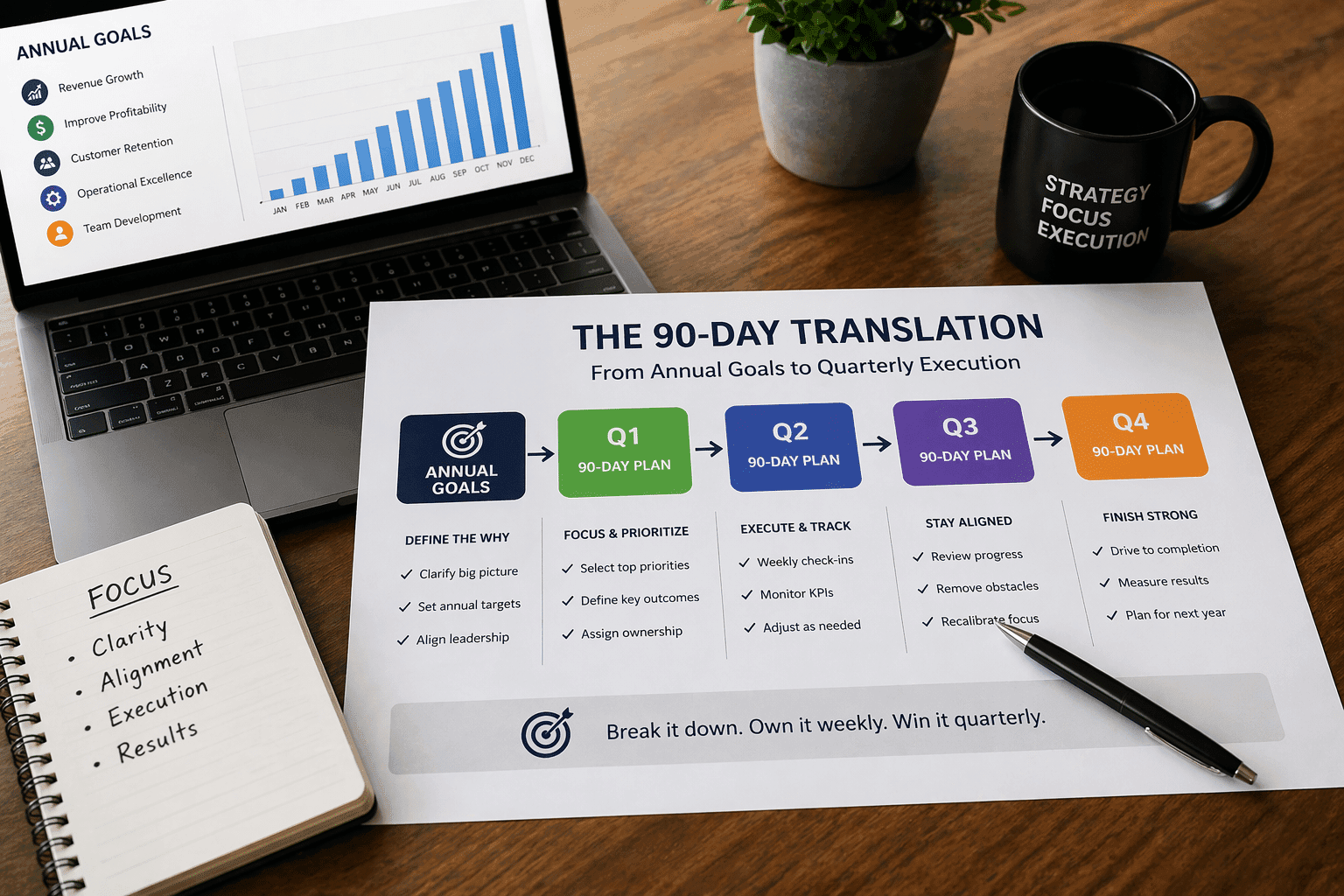
Even the strongest strategies have a common vulnerability: the gap between an annual goal and how the team goes about executing that plan. An annual goal gives the company direction, but it doesn’t tell anyone what to do this week, who owns what, or set targets along the way to encourage progress and momentum. That gap — between the direction set in January and the work happening on the ground month after month — is where strategic plans lose traction. Here’s a practical guide to turn annual goals into executable 90-day plans.
A Quarterly Goal Builds Accountability
A quarterly goal is not a project, a theme, or a scaled-down version of the annual goal. It’s a 90-day commitment — specific enough to act on, narrow enough to own, and measurable enough to confirm whether it moved at the end of the quarter.
For many leadership teams, the line between an annual goal and a quarterly goal blurs in the planning session. “Grow revenue” is an annual goal. “Close five enterprise accounts in the Northeast by the end of Q2” is a quarterly goal. One sets the direction. The other creates accountability. The annual goal tells the team where the company is headed, while the quarterly goal tells a specific person what they’re responsible for delivering by the end of the quarter.
That translation applies across every part of the business:
- “Improve customer retention” becomes “Reduce churn from 8% to 5% by end of Q2 — owned by the VP of Customer Success.”
- “Build a stronger leadership team” becomes “Complete the Director of Operations hire and 90-day onboarding plan by end of Q3 — owned by the COO.”
- “Increase operational efficiency” becomes “Cut order fulfillment time from five days to three by end of Q2 — owned by the Operations Manager.”
In each case, the annual goal stays on the wall. The quarterly goal goes on the scoreboard.
A well-built quarterly goal meets the SMART framework — specific, measurable, and time-bound — with one addition the standard framework skips: a single named owner. Without ownership, a SMART goal is still a well-written intention. The owner is what turns the framework into an action plan — one person accountable for the outcome, with their name on the result at the end of the quarter.
Why 90 Days Is the Right Unit of Execution
Ninety days is the most effective execution window available to a leadership team. It’s long enough to accomplish something meaningful, short enough to keep urgency alive.
Annual goals lose their impact fast. By the second month, the year feels long, and competing demands take over. The goal that felt critical in January becomes a background objective by March because there’s no near-term accountability attached to it. Quarterly goals solve that by creating a deadline close enough to feel real. Eight weeks out, the goal isn’t abstract — it’s urgent.
Monthly goals create the opposite problem. Thirty days isn’t enough runway to build meaningful momentum on anything strategic. Teams end up executing tactics rather than the sustained effort a real goal requires.
The 90-day window also forces a useful reframe. Instead of asking “how do we accomplish this annual goal?” the question becomes “what does meaningful progress look like in the next 90 days?” That distinction matters. A company can’t open a new market in a single quarter — but it can identify the top target accounts, build a pipeline, and close the first two. That’s the 90-day version: concrete, achievable, and clearly connected to the annual objective.
The leadership teams executing at the highest level have built this rhythm into their operations. They translate the annual goal into a 90-day goal, execute it, review it, and translate it again. Four quarters of that discipline compound into the kind of consistent execution most organizations only hope for.
What a Vague Goal Costs the Team
When a goal is unclear, the team doesn’t stop working. It’s worse. They keep working, but in different directions, toward different interpretations of the same objective. The cost doesn’t show up until the end of the quarter, when the results don’t match the plan, and nobody can explain exactly why.
Donald Sull, Rebecca Homkes, and Charles Sull identified this pattern in their 2015 Harvard Business Review study of more than 400 companies. Only 55% of middle managers could name even one of their company’s top five priorities. When the people responsible for executing the strategy can’t identify the goals, the translation has already failed — before the work starts.
A vague goal diffuses ownership, makes accountability impossible, and erodes trust in the planning process itself. After several quarters of real effort producing inconsistent results, teams stop believing the plan matters — because they’ve never seen one execute cleanly. A clear goal — specific, owned, time-bound — closes all three gaps before the quarter starts.
The Translation, Built For You
For many leadership teams, the challenge is installing a reliable system to consistently run quarterly execution. Without one, teams skip the translation, rush it, or run it differently every quarter.
Align is built for exactly this. The goal-setting process is structured into the platform — from the annual goal to the quarterly goal to the individual task, with ownership assigned and visibility built in at every level. The translation happens every quarter, on time, with clarity.
For teams that want to translate annual goals into quarterly targets starting today, Align’s free AI Priority Creator does the work in seconds. Enter the strategic goal, and the tool defines the quarterly goal and tasks needed to accomplish it — a starting point that removes the friction of a blank page and gives the team something concrete to react to, refine, and own right away.
A strategy that never gets translated never gets executed. The annual goal sets the direction, while the quarterly goal closes the distance between that direction and the team’s daily work. Four quarters of clear goals, owned by specific people, reviewed on a consistent rhythm — that’s not just better planning. That’s how strategy becomes culture.
Start by translating one annual goal into a 90-day target. Get it right, keep reviewing it, and this year’s strategy starts to take care of itself.
Smart moves today. Big wins tomorrow.
See how Align builds the system that reinforces execution → Show Me The System