
Growth-stage CEOs evaluating an execution platform worry about choosing the wrong one. Wrong fit. Wrong timing. Too much change at once.
Those are legitimate concerns, but they focus on the wrong measure.
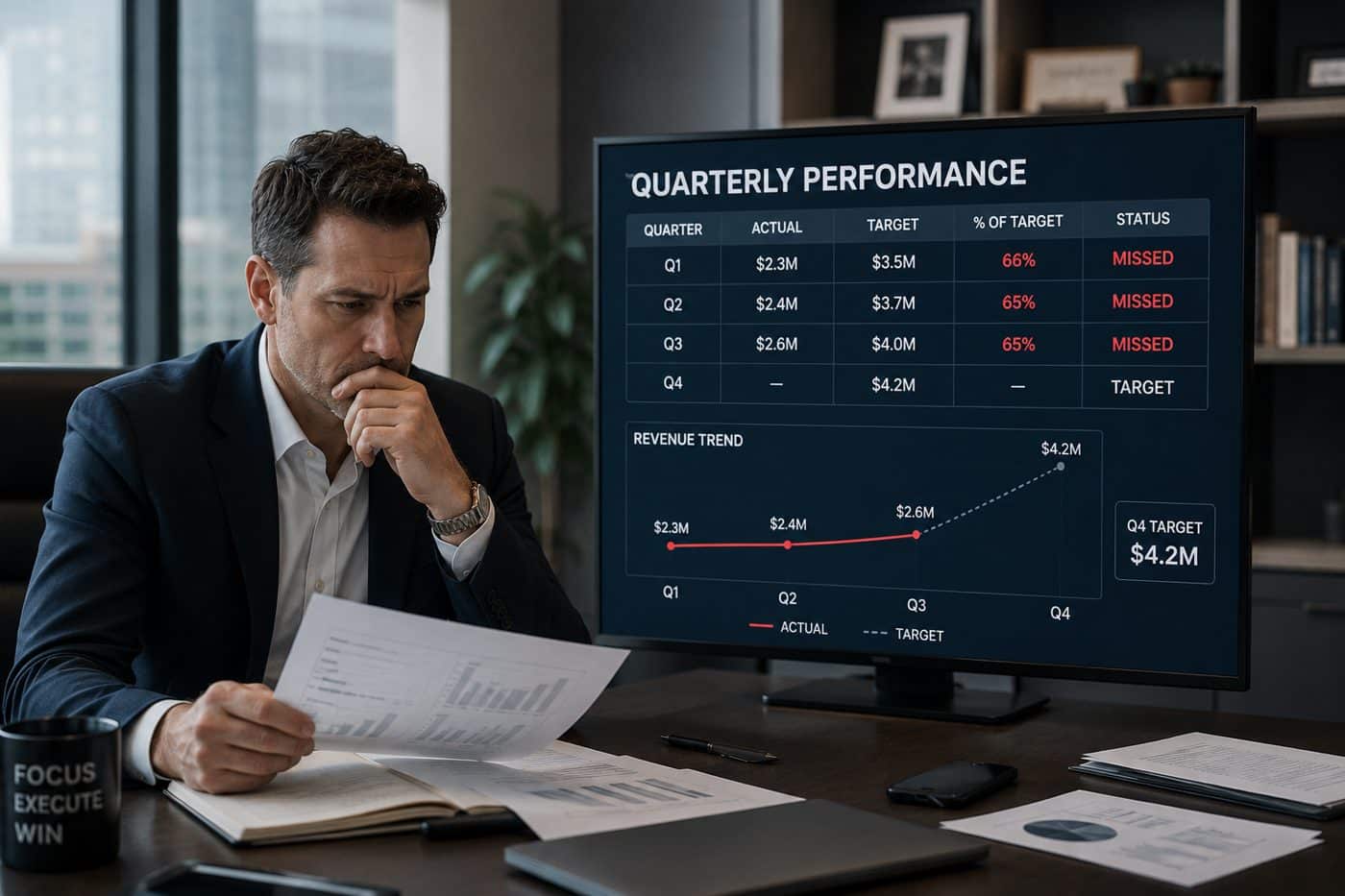
The cost of repeat quarters falling short of goal doesn’t show up on a balance sheet — but over time, it causes significant damage to the business.
Here’s what that cost looks like in practice:
- A goal that was on track in January sits at 65% in March, with no escalation path
- An initiative that was supposed to drive revenue this year is still “in progress” from last year
- Your leadership team spends the first 20 minutes of every 1:1 clarifying what the priority actually is this quarter
None of these is a catastrophic moment on its own. But they accumulate — and by the time they surface in the review meeting, the quarter is already closed.
Why Strategic Initiatives Stall Before the Quarter Ends
It’s common for strategic initiatives to drift. A manager gets pulled into something urgent in week three. By week eight, the goal is yellow. By week twelve, it’s the thing someone explains in the review meeting.
Four to twelve weeks of untracked drift is where initiatives die, not from bad strategy, but from the absence of a weekly visibility system that would have caught the problem while there was still time to fix it. Bain and Company research published in Harvard Business Review found that a single weekly executive meeting can consume 300,000 hours of organizational time annually, once you account for all the prep, follow-up, and cascading sessions it triggers. That’s how much invisible time is already leaving your organization before a single goal slips.
A goal at 65% completion delivers close to zero of its intended value, and Harvard Business Review research shows that leaders consistently overestimate how aligned their teams are on strategy, which means partial completion often goes undetected until it’s too late to recover. The market entry that didn’t launch doesn’t generate revenue. The operational improvement that stopped short doesn’t reduce cost. The hire that took 12 weeks instead of 6 delayed the team’s output for another full quarter.
Those aren’t hypotheticals. They’re the items on every year-end list of “things we didn’t finish.”
What You’re Actually Comparing
The hesitation is understandable. Evaluating a new platform takes time. Rolling it out requires change management. The team has a lot going on. This quarter is particularly busy.
Every one of those statements is equally true in the next quarter.
The comparison isn’t between your current state and a perfect future state after a seamless implementation. It’s between your current state and your current state plus one more quarter of the same outcome. That math rarely gets examined directly — but it’s the calculation that actually determines whether waiting was the right call.
Consider a 40-person company with a $70,000 average salary. MIT Sloan research across 124 organizations found that only 28% of executives and middle managers responsible for executing strategy could name three of their company’s top priorities. If the people executing the strategy can’t identify it, misdirected effort isn’t a risk; it’s a near certainty. If just 15% of a 40-person team’s effort is pointed at the wrong priorities, that’s roughly $420,000 in annual payroll producing no strategic return. One quarter of that is $105,000, and it’s a carrying cost that compounds every quarter if the system doesn’t change.
What Is an Execution System?
An execution system is the operating layer that connects your annual strategy to your team’s weekly work. A strategic plan in a deck tells you where you’re going. An execution system is a repeatable set of actions that gets you there, and exposes challenges in time to do something about them.
A working execution system has four components:
- Number visibility. Your key metrics are tracked weekly, not reviewed monthly. Every leader can see whether the numbers that drive the business are trending in the right direction, and who owns them if they're not.
- Goal accountability. Annual goals are broken into quarterly priorities, each with a single named owner and a clear completion standard. Shared ownership means no ownership.
- Meeting cadence. A consistent weekly leadership meeting keeps the team connected on what's moving, what's at risk, and what needs a decision, without waiting for the monthly review to find out the quarter is already off track.
- Strategy first. Every priority, KPI, and goal ties back to the company's annual strategy. The team doesn't have to guess whether their work matters this quarter. They see it, and they live it every day.
Without all four, you have pieces of an execution system. The habits that drive results only compound when the system holds them together.
Every Quarter You Spend Analyzing Is Another Quarter at That Cost
Choosing carefully is smart. However, spending three more quarters evaluating while the current system continues to produce the same results is a different problem entirely.
For many companies, that’s another $105,000 in carrying costs — x3!
The companies that close each year having hit their targets aren’t the ones that found the perfect tool. They’re the ones who made a decision early enough in the year for the rhythm to compound, therefore, goal achievement to become inevitable.
You don’t need another 3 quarters to figure this out. You need three steps.
- Calculate the cost of your current state. Use the Misalignment Cost Calculator to run your actual numbers — headcount, average salary, execution rate. It takes under two minutes. Once you see the quarterly figure, the evaluation timeline will look much different.
- Understand what the execution system requires. The Execution Blueprint is a free five-day course that walks through the exact structure — the four habits, the weekly rhythm, and how the system connects daily work to quarterly goals. Know what you're building and ensure the platform incorporates all four.
- See it running before you commit. The right platform builds your rollout around what you already have — a strategic plan in a deck, KPIs in a spreadsheet, quarterly goals in a slide. Onboarding should focus on how quickly you can transform these fragmented tools into a cohesive system. The goal is to get execution underway as quickly as possible.
What Changes When Your Strategy Execution System Is Running
The quarter you’re in right now will close whether or not you’ve made a decision. What will the number look like when it does?
With a functioning execution system, the goal that was drifting gets caught in week four instead of week thirteen. The owner who needed a decision from the leadership team gets it before the blocked goal turns into a miss. The conversation shifts from explanation to adjustment.
The difference is habits — how your team operates week to week. The right technology makes those habits easy to build and easy to sustain.
Learn how to install functioning execution habits with your team with the FREE Execution Blueprint. And if you’re like thousands of Align leaders who understand the power of a system to enforce these habits, get a walk-through today!
Smart Moves Today. Big Wins Tomorrow.
Align is strategic execution software for leadership teams who want plans to turn into results. More than 2,200 companies across 64 countries use Align to build consistent execution habits, run effective weekly meetings, and keep teams accountable quarter after quarter.Learn more at aligntoday.com.