
How Fast Can You Make a Decision?
4 Questions for Leaders Who Want to Scale Faster
Your biggest customer wants to triple its order volume starting next month. You'd need to add a second shift and a new laser-cutting line, plus seven operators to run them. Your CFO has already done the work to raise the credit line from $2 million to $3.5 million. The financing looks good, but what you can't answer yet is whether the plant can hire and train enough people, and whether on-time delivery is holding at today's volume. You’ll have to check with your plant manager and HR. So you say, "Let me get back to you after Thursday's meeting."
Delays like this one keep your company from scaling at the rate you want. Fast and smart travel together. In a McKinsey survey of 1,259 managers, organizations that make decisions quickly were twice as likely to make high-quality decisions as those that move slowly.
Most slow decisions trace back to one cause: lack of current information. Leaders who can pull up their numbers in a few minutes decide on the spot. Everyone else asks around or schedules a meeting to find out where things stand, and every decision stalls while an already stretched team picks up another meeting.
Here's how to make decisions faster. Use these four questions to test whether your company can decide fast enough to grow, and to pinpoint what to change.
1. Can you see where each department stands right now, without asking anyone?
At 15 people, it was easier to know where everything stood because you were next to them, working alongside them day to day. You walked the floor every morning and knew which orders were running late and what was running well. At 80 people, that same information is split between your ERP, a production schedule your planner keeps on his desktop, the HR system, and each department's data. Getting a straight answer takes a round of emails and a few days of waiting.
Making decisions like in the expansion example, you need two answers: whether on-time delivery is holding at today's volume, and how fast you can hire and train seven operators. Delivery numbers come from a report your plant manager pulls on Mondays, and it's Wednesday. Your HR manager owns the hiring pipeline, and they're at a job fair until Friday. So you send two emails and wait. Meanwhile, your customer is wondering whether you can handle the business.
Decision latency: the time between when a decision comes up and when someone has enough information to make it.
The fix: put the targets and actuals in one place
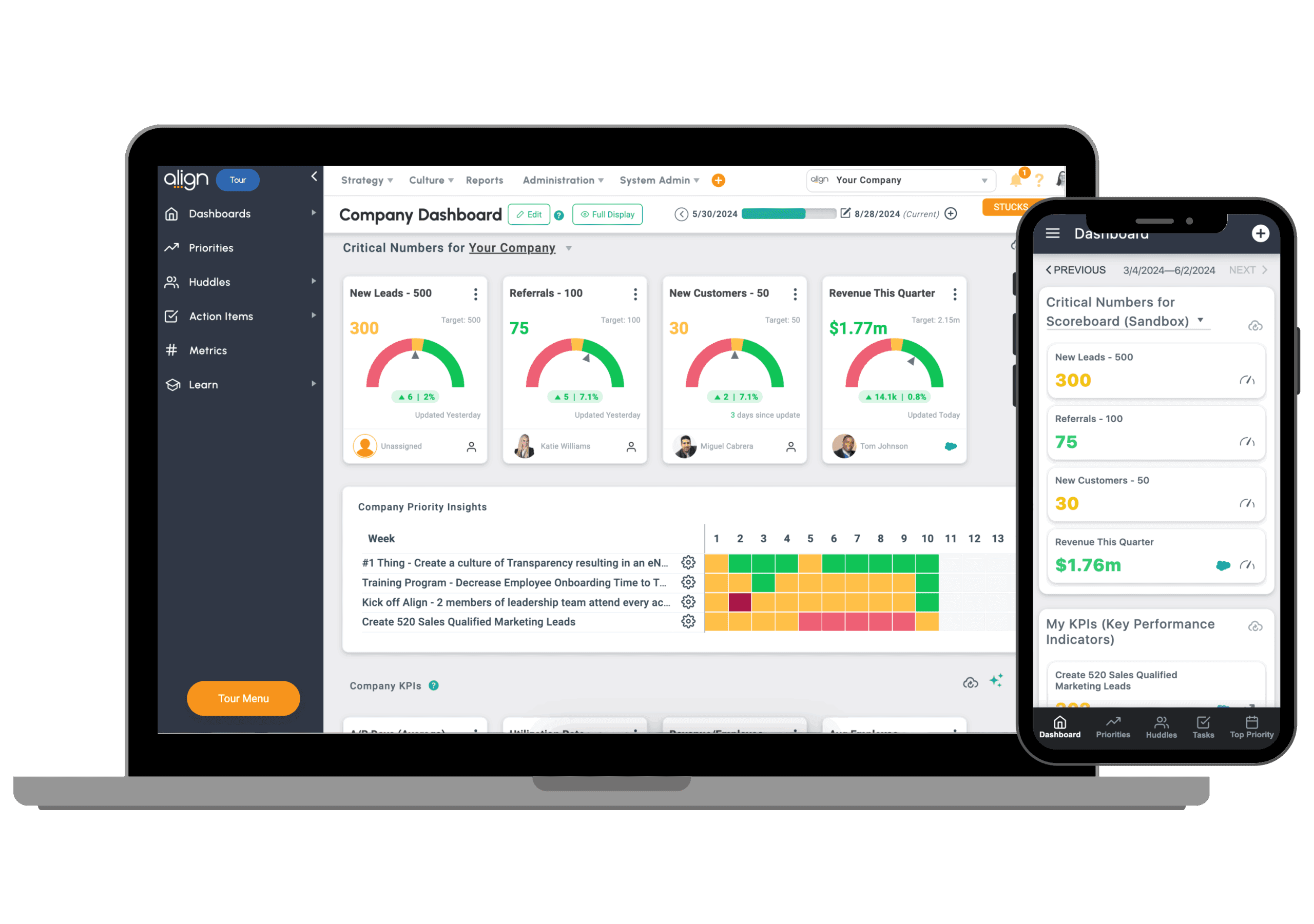
Put every department's goals, owners, and latest numbers in one view your leadership team can open anytime. Pull what you can automatically from the systems you already use, and have each owner update the manual numbers on the same day every week. Then on-time delivery and the hiring pipeline are a click away, and you can give your customer an answer before you hang up.
Beth Winkler, CEO of Magnolia Physical Therapy, centralized their targets and KPIs in one shared system so she could see daily status. As she told Align, "There's no reason to email, because I know I'll see them in our 10-minute Huddle later that morning."
2. Do you know which goal is most off track this week, and who needs help to move it forward?
Go back to that on-time delivery question. For eight weeks, the weekly update was the same: “We’re on track.” Then the quarter closed, and on-time delivery came in at 60% of target. The number your customer cares about most slipped right past your team. Nobody was hiding anything. The updates described effort, not results, and without a number tied to the goal, the team couldn't spot the gap until it was too late to close.
Darrell Morton saw the same pattern play out across two companies. He runs DMSS, an aquatic sports company in Botswana, and partners with LMI, a design firm in Cape Town. Before his teams used Align, nobody had a clear view of who owned what, so his teams revisited the same goals in every meeting just to keep them from slipping. They had a 30-page strategic plan that "nobody ever read."
The fix: give every goal one owner, a target, and track progress
Single-point ownership: one named person accountable for each goal and the number that measures it.
Darrell's teams replaced the 30-page plan with a one-page view where each person owns a number. "Each person having ownership of a number or metric made accountability real," he said. The result, as he put it: "It's clear if somebody's had a good week or not."
When every goal has one owner, you know exactly who to ask, and often you don't need to ask at all.
3. Does your team make decisions in the meeting where they come up?
Growth multiplies the decisions on your desk. The expansion example alone brings a dozen: who supervises the second shift, whether to run overtime until the new operators are trained, and which orders move to the new laser line first. Each one needs an answer this week, and the leaders who scale fastest make those calls as they come up.
Those calls are often left for the weekly meeting. By Thursday, the list has grown to 15 items, the meeting covers four, and the rest roll to next week while the second shift waits on a supervisor and your customer waits on a ship date.
The good news: you already have the time. In a McKinsey survey of 1,259 managers, respondents spent 37% of their time on decision-making, and 61% said they used most of that time ineffectively. Recover even part of that time and your leadership team can make more decisions without adding hours to the week.
The fix: a meeting rhythm built for decisions
When updates arrive before the meeting, your team can get straight to decisions. Two habits make that possible:
- A short daily huddle. Fifteen minutes that cover each person's number, today's focus, and anything blocking them. Problems surface while they're small. In Align's study of 1,900 companies, teams that ran their huddles in Align completed 60% more goals.
- A weekly leadership meeting that skips the status round. Everyone has already seen the numbers, so the team spends its time moving off-track goals forward and making the calls they need.
With current numbers in front of everyone, each call gets made with confidence as soon as it comes up. In the expansion example, it means your plant manager approves overtime the day training falls behind, and your production lead moves an order to the new laser line as soon as capacity opens. Your team keeps moving, and the list never has a chance to pile up.
Every decision that waits for the next meeting puts revenue, on-time delivery, and your customer's confidence on hold.
4. Can your leaders make routine decisions without waiting for you?
Back to the expansion example. Your plant manager needs approval to post the seven operator jobs. Your production lead wants to move two orders onto the new laser line. Both are capable of making those decisions. What they lack is a clear view of how each one affects the company's goals, and the confidence that you'll back their judgment. So both wait for you.
While they wait, hiring slips a week, the new line sits idle, and the ship date your customer is counting on moves closer.
You've made these calls for years, and it's a big part of why the company got this far. At this size, it's also what slows everything down. In 2025, Wes Kuhl, President of Horizon Systems, saw how fast this approach had to change when the leaders who built the company began transitioning out. Newer leaders promoted from within stepped into roles that asked them to think about the company as a whole, whereas in years past, they only had to consider their single department. That's a hard shift when the company's strategic direction comes up only once a year at a planning session.
The fix: empower leaders with clear expectations
Clear expectations give your leaders the confidence to act. Spell out which goals each leader owns, the number that shows whether each one is on track, and the decisions that are theirs to make. Your plant manager can approve overtime and post open roles within the hiring budget. Your production lead can schedule orders on the new line as capacity opens. You step in on the calls only you can make, like pricing a new contract or adding a third shift.
For Horizon Systems, every goal and its owner sits on a color-coded dashboard, so everyone can see what's on track and where a teammate needs support. The leadership team meets weekly, and every quarter each department reports its progress against the one-page strategic plan. When someone spots an issue, they log it and tag the people who need to see it. "Nobody's surprised when you get into a conversation with them, because they've seen it," Wes said.
In about two years, that clarity helped its newer leaders go from running departments to thinking about the whole company. They now come to quarterly planning ready to talk about core capabilities, target markets, and where the company is headed long term, questions Wes says Horizon wasn't even asking before. "We're talking about where we're going and how we're gonna get there," he said. With several large projects driving growth, Wes expects 2026 to be one of Horizon's best years.
When your leaders have the information and the confidence to decide in line with your strategic goals, decisions stop routing through one person, and your expansion moves at the speed of your team instead of your calendar.
Start with your meetings
Go back to that order. With every department's numbers in one place and leaders who know which calls are theirs, you answer your customer in a day instead of after Thursday's meeting. You don't need to fix everything at once. Start with the meeting you already run every week, and make it the place where decisions get made.
Faster decisions come from current numbers that every owner keeps up to date, and a meeting rhythm your team can rely on. Put those in place and you'll run fewer meetings, because everyone already has the information those meetings used to collect. The meetings you keep become better meetings, focused on decisions and progress.
5 Days to Better Meetings is a free email course with one practical lesson a day. It walks you through setting up that rhythm, so your team brings its numbers to every meeting and makes decisions on the spot.
Start the free 5-day course →
Frequently asked questions
How can leaders make decisions faster? Keep your goals and numbers visible in one place, give every goal one owner, and run a short meeting rhythm so problems surface early. With the information ready, you can make most decisions on the spot.
Why do leaders make decisions more slowly as the company grows? As a company grows, information spreads across more people, spreadsheets, and tools. Leaders have to ask around or wait for a meeting to learn where things stand, so decisions stall until the next meeting.
Does making decisions faster hurt decision quality? Usually the opposite. In a McKinsey survey of 1,259 managers, organizations that made decisions quickly were twice as likely to make high-quality decisions as slow decision makers.
How much time do leaders spend on decisions? In McKinsey's survey, respondents spent 37% of their time on decision-making, and 61% said they used most of that time ineffectively.
What is decision latency? Decision latency is the time between when a decision comes up and when someone has enough information to make it. In growing companies, it's often the biggest hidden drag on speed.
How can I tell if my company decides fast enough to grow? Ask whether you can see where every goal stands without asking anyone, and whether your team makes most decisions in the meeting where they come up. If you answer no to either, outdated information is slowing you down.