Every C-suite leader has sat through a weekly review where commitments were made, heads nodded, and action items were written down. Then everyone walked back to their departments, and the daily work swallowed the week whole.
The following week, the CFO asks where the quarterly cost initiative stands. You already know how this is going to go.
- The ops lead gives a number that doesn't match what the COO heard last week.
- The head of sales says the pipeline priority is "moving" but can't give a percentage.
- Someone mentions a blocker that's been sitting unresolved for two weeks — this is the first time it's come up in a meeting.
By the time you're done, you've spent 50 minutes on updates that should have taken 15, made two decisions that should have been made last Thursday, and scheduled three follow-ups that will probably surface next Monday again.
What Your Weekly Meeting Could Look Like Instead
Picture a different Monday.
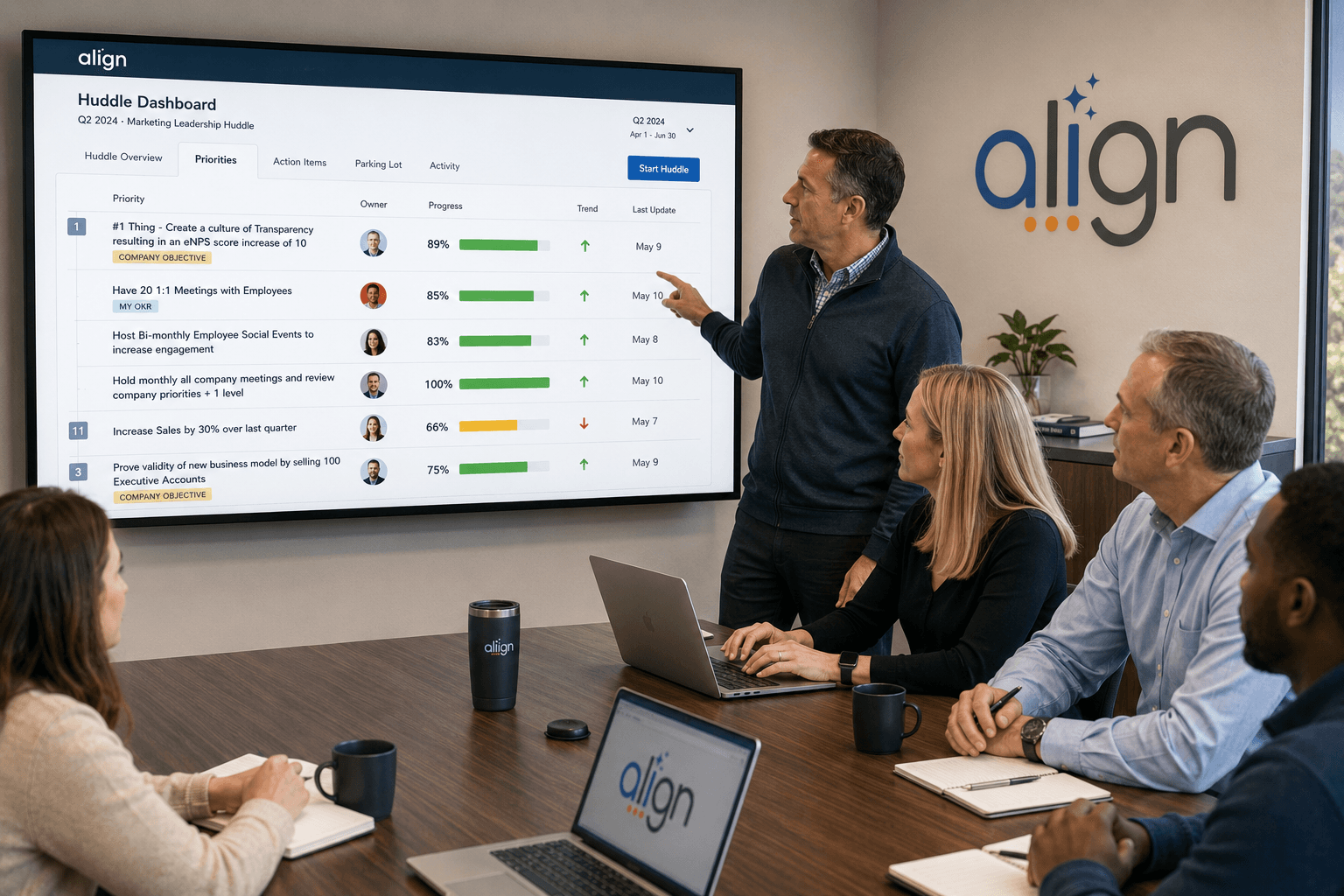
Every goal is updated with a color and relevant metric indicating progress.
One KPI has been trending down for two consecutive weeks; the owner flagged it on Friday, noting what's causing it and what they're doing about it.
A priority that was yellow last week moved to green.
One hasn't been updated since Wednesday, which tells you it needs a conversation.
You walk into the meeting already knowing where everything stands. The CFO has seen the same view. So has the COO. The question isn't "where are we?" — everyone already knows.
The question is "what do we do next?"
That meeting now runs 25 minutes or less, and everyone leaves knowing exactly what they own for the week ahead.
That's not a fantasy version of a leadership meeting. It's what happens when the meeting structure is doing its job.
Three Habits That Keep Your Meeting On Track
There’s a difference between a meeting that runs long because there’s a lot to cover and one that lacks structure.
Here are three ways to build that structure into your meetings:
- Assign a facilitator — one person responsible for starting on time, rotating through updates, and keeping conversations from going sideways.
- Require written updates before the meeting starts, so the first five minutes aren't spent reconstructing what happened last week.
- Use a parking lot for anything that pulls focus: if a topic runs past its time, name it, set it aside, and schedule a separate conversation.
Align's Huddle tool naturally incorporates this structure into the meeting. Each huddle has a customizable agenda, a shared workspace where team members log their "What's Up" updates before the meeting begins, and a built-in parking lot for off-topic items.
The impact of this structure is palpable. We analyzed over 1,900 companies and 435,000 priorities over a four-year period and found that companies using huddles set 48% more goals per quarter, complete 60% more goals, and 100% report improved communication across their teams.
Their meeting content didn't change. The structure around it did.
Reinforce the Habits
Built-in Accountability
The vague updates and unresolved blocks are typical when it isn’t clear who specifically owns each goal.
Align's Priority Creator answers that question before the work begins. Each goal/priority is built with a single named owner, a defined success metric, and a target date. For example, when your head of sales enters the quarter knowing the pipeline priority has their name on it, and that every member of the C-suite can see its status on any given Thursday, the behavior changes. They're not waiting until Monday to flag a problem. They're raising it mid-week, when there's still time to act.
Research on felt accountability shows that individuals with personal ownership of an outcome perform measurably better than those who share it. The Priority Creator makes that ownership explicit — visible to the entire team and tied to the plan.
Every Number Has a Face
The ops lead and the COO gave different numbers because they were drawing from different places. One pulled from a report. One from a view in the ERP.
KPI Cards in Align are an immediate fix to this disjointedness. Every critical metric requires a named owner, and everyone on the team sees the same view. When your COO checks their Align Focus Hub on Thursday, they're seeing the same number the CFO will reference Monday morning. Same system. Same update. No discrepancy.
The cascading priority structure adds depth beneath those numbers. Company priorities sit at the top while department priorities roll up beneath them automatically as owners log progress. You can see, at any point in the week, how each department is tracking against the quarter. No status meeting required.
What this eliminates from your Monday agenda:
- The number debate — one source, updated by the owner or via automated integrations, visible to all
- The subjective progress update — percentage completion and trend data are already in the system
- The surprise yellow flag — KPI Cards surface movement mid-week, before it becomes a Monday problem
Assign Who Will Remove the Block Before Anyone Leaves the Room
That issue that keeps surfacing each week?
Align's Huddle tools facilitate handoffs so that any issues blocking progress are assigned before the meeting adjourns. An owner and a deadline are linked directly to the relevant goal, making it visible to the team with a clear due date.
The following Monday, you can see whether it was completed before the meeting begins. If it wasn't, you know who owns it, which makes the follow-up conversation 90 seconds instead of ten minutes.
Additional Support for Your Most Important Goals
If your team is working toward quarterly goals and needs more than a better meeting format, Align gives leaders a system to support execution between meetings too. These tools give your team the structure to stay on track without waiting until Monday to find out they aren't.
A meeting recap is pushed automatically to all participants after each huddle. Instead of multiple versions of notes, a written record of what was covered, what was decided, and what's due is sent to each member.
Align's built-in 1:1 templates give the C-suite and department leaders a structured midweek touchpoint with each direct report, centered on their active priorities and KPI updates.
What moved? What's at risk? What needs a decision?
Action items get logged directly in the system, attached to the priority they affect. The 1:1 record stays with the huddle, so follow-through is visible the next time you meet.
Run A Meeting That Sustains Momentum
The weekly leadership meeting doesn't just need to be shorter. It needs to sustain momentum.
When every priority has a named owner, every metric has a face, blockers get assigned before anyone leaves the room, and midweek check-ins clear what's stalled — Monday changes. The CFO and COO walk in with the same view. The head of sales has a number, not a feeling.
The conversation moves to what needs to happen next to keep the quarter on track.
Companies using Align see a 3.5x increase in the number of strategic goals completed between month one and month fifteen. The majority report that changing the meeting structure directly impacted this success.
Start a free trial of Insights by Align today and walk into next Monday already knowing where every priority stands and ready to hit more quarterly goals.