
What a Compounding-habits System Really Does For Your Company Strategy.
The companies executing at the highest level share a common advantage: they build execution habits into their culture.
Not better data or more sophisticated reporting, but a discipline that grows stronger every quarter. That’s the compounding effect of strong execution habits. And it’s what separates organizations that grow from organizations that scale.
What Compounding Execution Actually Means
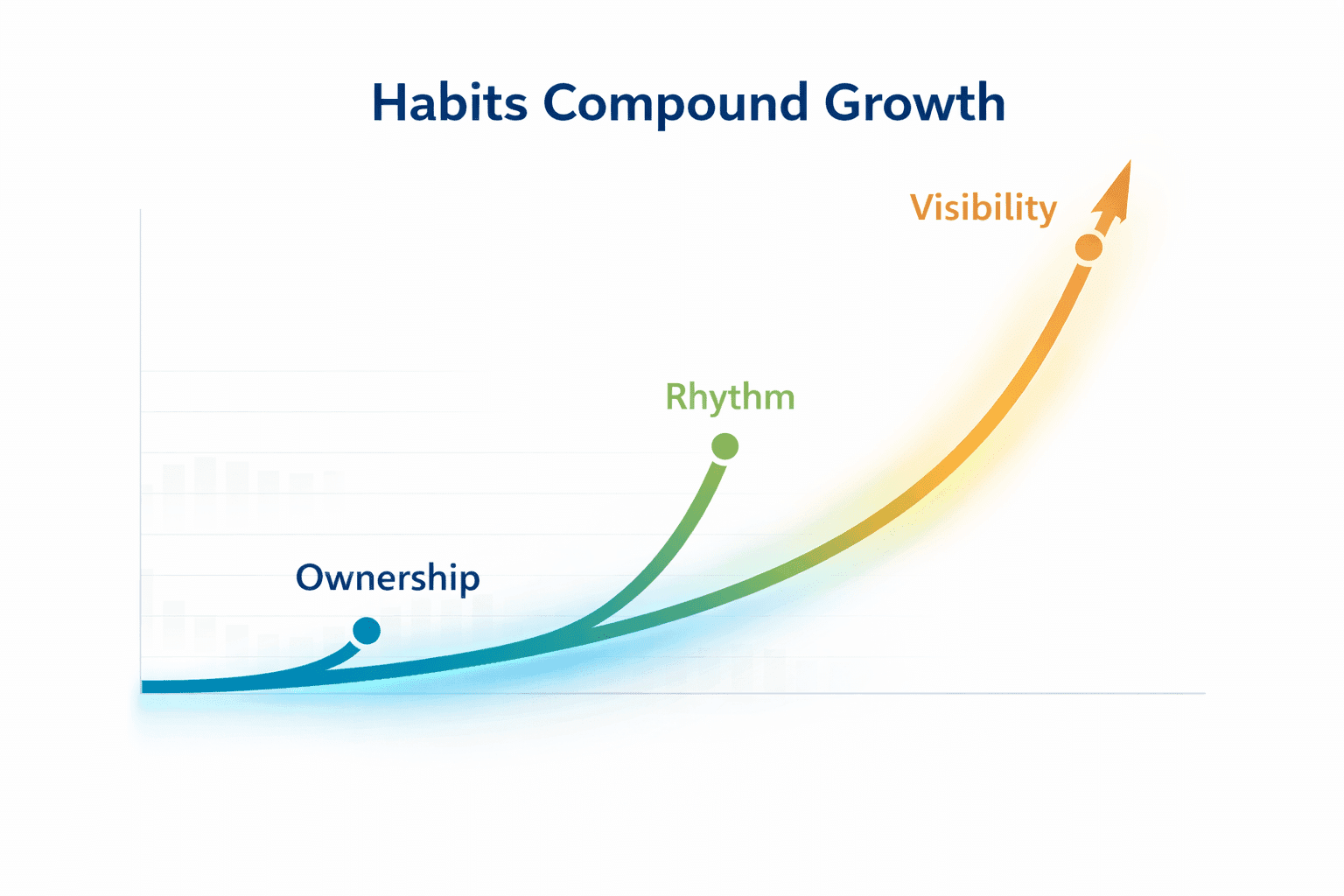
Like compounding interest, compounding execution means each cycle builds on the last. The return in year three isn’t just more than year one; it’s accelerating.
For example, building the habit of ownership requires deliberate effort. Assigning a metric to a specific person, making it visible, and holding a consistent weekly review can feel clumsy because they are new behaviors. But even after a single quarter, they start to feel routine. Expected.
By quarter three, they’re cultural. The organization holds each other accountable without anyone managing it.
That’s the compounding mechanism. Each repetition makes the next one easier, more automatic, more independent of leadership intervention. The return on the habit grows every quarter it runs.
There are four execution habits that compound fastest, and they are the ones that change the culture inside your business.
The Three Habits With the Highest Compound Return
Ownership: From assigned to automatic
Every high-performing organization faces a similar challenge: making accountability a cultural expectation rather than a management task. LHH’s Global Leadership Accountability Report surveyed 1,900 executives across 20 countries and found that 72% said accountability was critical to their organization — and only 31% were satisfied with how their leaders demonstrated it. That’s a significant gap.
The ownership habit closes it structurally. Every priority has a single owner. The whole team sees who owns it. The weekly check-in runs consistently and without exception.
In quarter one, this requires intention. By quarter three, it’s the default. Nobody waits to be assigned — they claim ownership because the culture now expects it. Gallup’s State of the American Managerresearch found that managers account for 70% of the variance in employee engagement. When a system reinforces ownership consistently, it becomes the driver of that engagement.
Rhythm: From scheduled to self-sustaining
The organizations that execute best work with a more consistent cadence. Their weekly execution rhythm includes a short, structured check-in where the team reviews what’s on track, what’s drifting, and what needs a decision. This changes how quickly the team identifies and solves problems.
In quarter one, leadership drives the cadence. By quarter two, the team has internalized it. By quarter three, it runs without the CEO in every room. Teams self-correct in days instead of discovering problems at the end of the quarter. The rhythm supports accountability, and leadership focuses on advancing goals rather than managing every little issue.
The compounding effect here is speed. Every quarter the rhythm runs, the organization gets faster at catching drift and correcting course.
Visibility: When the scoreboard is shared, the game changes
Behind almost every alignment gap sits the same root cause: the numbers that matter are visible only at the top.
People navigate by what they can see. A shared scoreboard — visible, reviewed weekly, owned at every level — changes what they see, which affects what they do. A front-line employee who can see that customer retention is tracking 4% below target in Q3 doesn’t need a manager to explain why retention calls are the priority this week. The number does that work.
That visibility compounds. The team that sees the same numbers weekly builds a shared language for where they’re winning and where they’re falling short. Conversations shift from status updates to decisions. Leaders spend less time translating strategy into priorities and more time closing the gaps that the scoreboard makes impossible to ignore.
Start Bigger: Move from project management to strategic execution
A team can have clear ownership, a consistent rhythm, and a visible scoreboard — and still be executing the wrong things.
Kaplan and Norton found that fewer than 10% of employees understand their company’s strategy. When priorities aren’t anchored to strategic intent, most of the team ends up working hard on things that have no clear connection to where the organization is trying to go.
For many companies, the priority list grows from the bottom up. The list usually reflects activity, not strategy. This habit starts at the top. Not the top of the org chart, but the top of the strategy. A priority earns its place on the quarterly plan when you can identify which strategic objective it advances.
Every owner knows why their priority exists at the highest level, so ownership becomes more meaningful. The weekly rhythm moves from task list reviews to discussions around whether the strategy is moving. That’s the shift from project management to strategy execution.
Habits Deliver Beyond the Dashboard
Knowing where execution stands is valuable, but acting on it structurally is what changes a company’s trajectory.
The organizations that execute with strength use reporting as a reference point and habits as the engine. The dashboard tells them where they are. The habits generate momentum toward growth. Two distinct tools that serve two different purposes, and the strongest teams invest in both.
This distinction matters because habits improve the organization over time in a way that reporting alone cannot. A dashboard in month twelve gives the same output as month one. A habit in month twelve runs faster, operates more automatically, and sits deeper in how the organization works than it did on day one. That’s the compounding advantage — and organizations build it by investing in the system that supports it.
What a System Builds
Align structures its system around these four habits. Huddles create the rhythm. Priorities cascade from leadership to every level of the organization. The system doesn’t just report on execution. It shapes how the team executes.
Here’s what that looks like in practice: A $15M professional services company implements Align at the start of Q1. The first quarterly review is still finding its footing — three of six priorities have clear owners, two are developing, and one needs to be reset. The leadership team reviews the scoreboard and uses the “Start, Stop, Keep” method to course-correct. Q2 launches with tighter ownership and a more consistent huddle cadence. By Q4, the team hits its quarterly goals.
The system reinforces the habits that create this momentum and real growth, quarter upon quarter.
The compounding advantage is available to any organization willing to build the system that creates it. The habits are learnable. The rhythm is buildable. The results follow, and they accelerate every quarter the system runs.
The only variable is when you start.
See how Align builds the system that reinforces execution → Show Me The System