Best Team Meeting Software for Accountability: What Keeps Your Team on Track
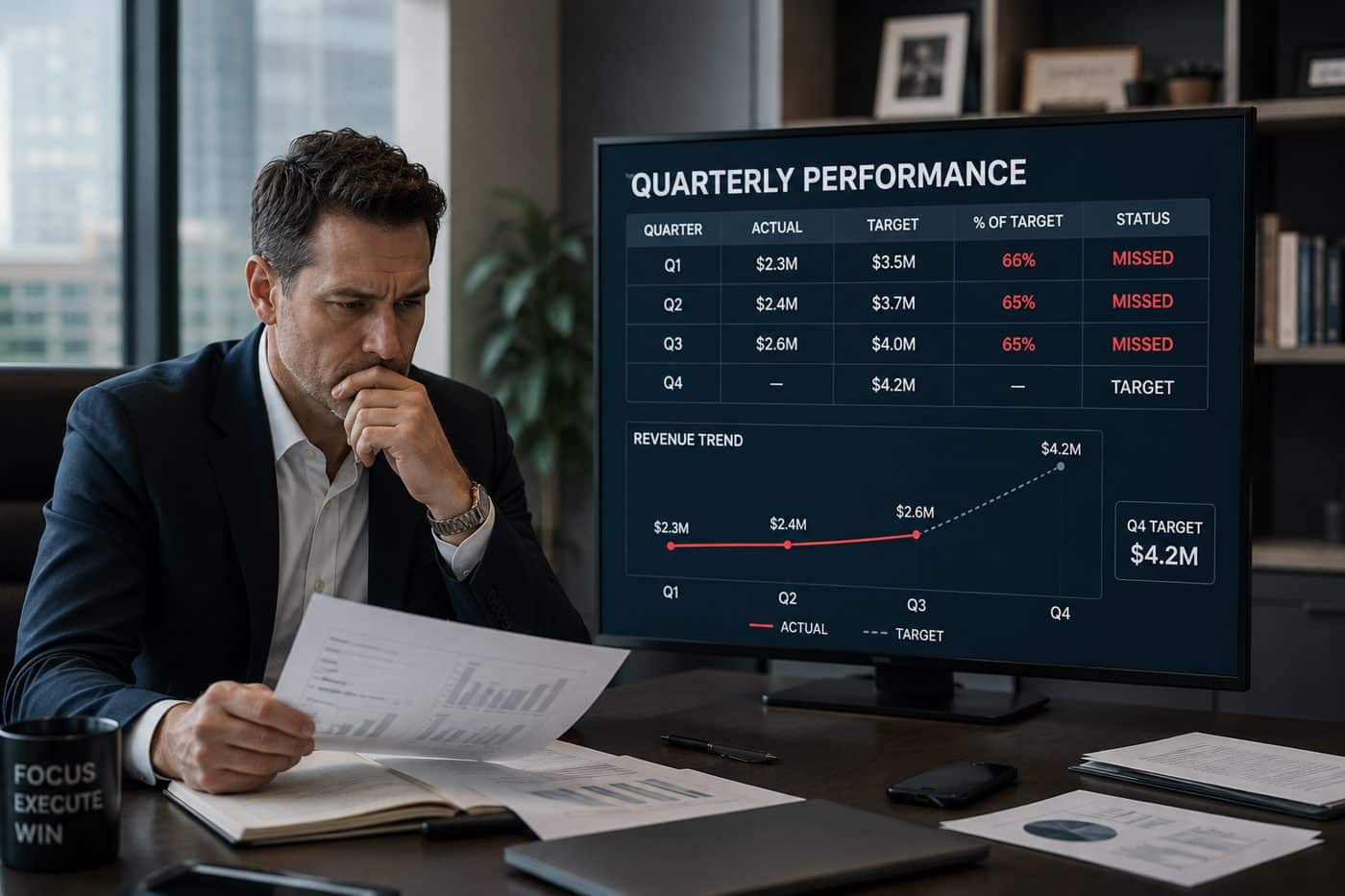
Right now, thousands of leadership teams are holding more meetings than ever — and getting less from them. The problem is that your meetings aren’t connected to execution.
If you’re evaluating team meeting software, the right question isn’t which tool has the most features. It’s which tool turns your weekly meetings into repeatable results, and how it helps you do it.
Why Most Meetings Fail to Drive Accountability
Before looking at software, it helps to understand what you’re trying to fix. Yes, it’s meetings, but what’s not working?
Harvard Business Review research found that 71% of senior managers say their meetings are unproductive and inefficient — and 65% say meetings prevent them from completing their actual work. These aren’t frontline employees complaining about too many Zoom calls. These are the people running the organization, and they’re spending the most expensive hours in sessions that don’t produce results.
The Atlassian State of Meetings survey, which covered 5,000 knowledge workers across four continents, put a sharper edge on the problem. 54% of workers frequently leave meetings without a clear idea of next steps or who owns which task. More than three-quarters (77%) say meetings routinely end with a decision to schedule a follow-up meeting. And 62% regularly attend meetings where no goal was even stated in the invite.
At first glance, you might think this is a time management problem, but it’s actually an accountability issue.
Meetings that adjourn without named owners for follow-up actions and visible follow-through aren’t really meetings — they’re just calendar obligations. They consume payroll, produce summaries, and repeat the following week.
The cost adds up. Unproductive meetings cost U.S. businesses an estimated $37 billion annually, with some broader analyses putting that figure closer to $399 billion when opportunity cost is factored in. For a growing company with a 30-person leadership team, hours lost to unfocused, recurring meetings translate directly into delayed decisions, missed quarters, and significant payroll waste.
What “Accountability” Actually Requires in a Meeting System
Most meeting tools — video platforms, note-takers, AI report generators, scheduling apps — all solve the logistics problem and add some efficiency. They don’t solve the accountability problem.
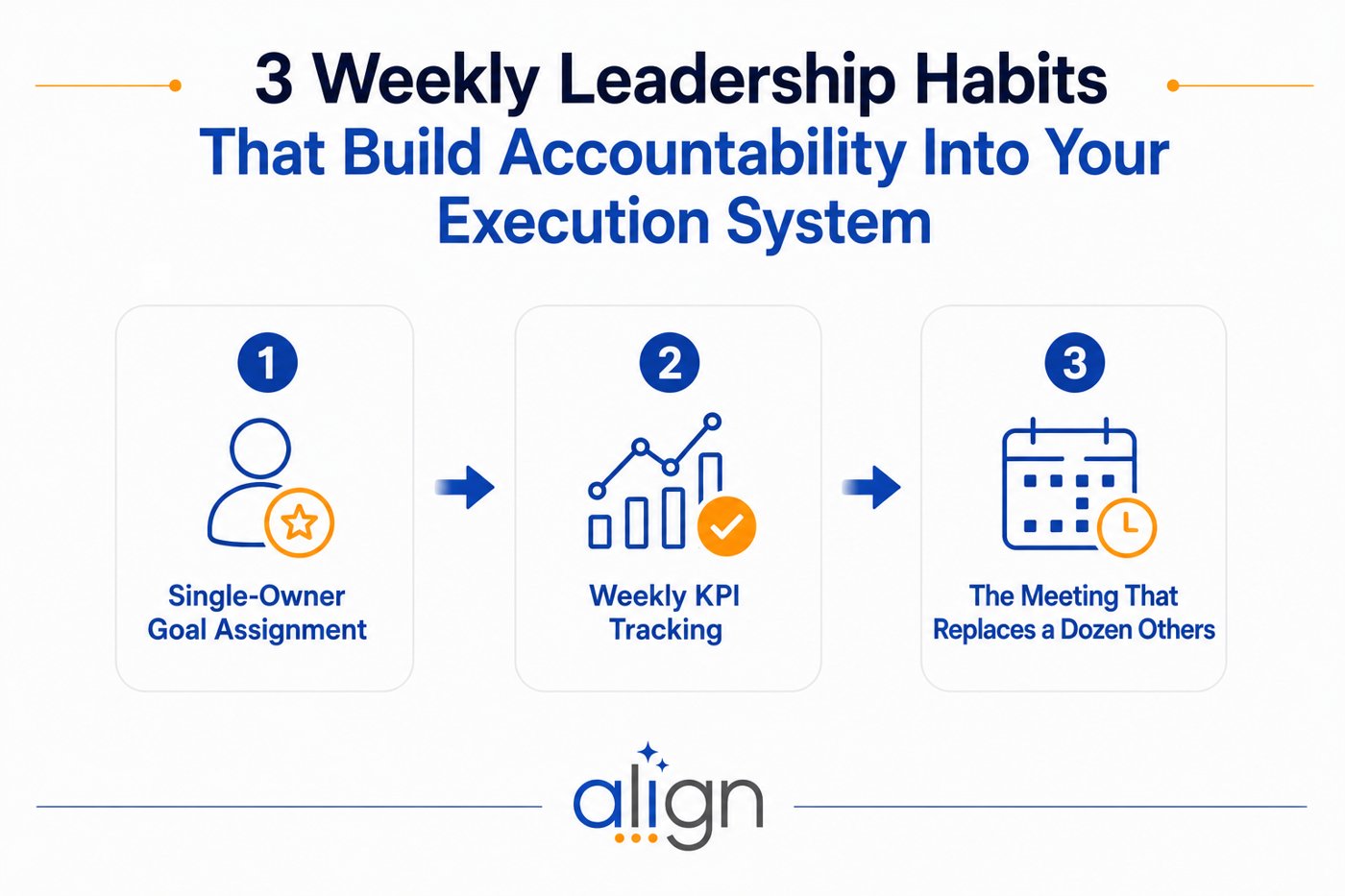
A meeting system that produces real accountability needs four things:
- A structured agenda tied to what the team is executing, not just a conversation and a task rundown.
When a meeting is built around the company’s quarterly priorities and KPIs, every conversation has a reference point. People come prepared. Discussion doesn’t drift. - Named owners on every open item.
Shared ownership is the same as no ownership. Every action, goal, or initiative that surfaces in a meeting needs a single named person responsible for moving it forward. Without that, the group ends the meeting feeling aligned, while nothing actually gets done. - Visible progress between meetings.
What happens in the 6 days between weekly meetings is where accountability lives or dies. If the only checkpoint is the next meeting, team members can coast until Thursday rolls back around. Visibility — on goal progress, KPI trends, and open priorities — needs to exist outside the meeting itself. - A direct connection to the team’s quarterly goals.
A meeting that isn’t connected to your quarterly priorities is just coordination overhead. The best meeting systems make it easy to surface which goals are on track, which ones are at risk, and who owns each one — before anyone has to ask.
What to Look For in Team Meeting Software for Accountability
Not every tool on the market is designed to produce accountability. Here’s what separates the ones that do from the ones that don’t:
Does It Run a Consistent Agenda Format?
Ad hoc agendas drift. Consistent formats set the expectation. The most effective meeting software gives the team a repeatable structure that covers what’s up, KPI updates, goals in progress, opportunities, and risks — every week, in the same order. That consistency is what builds rhythm, and rhythm is what builds accountability.
Does It Surface KPI and Goal Data Inside the Meeting?
The moment the team has to pull data from a spreadsheet or switch apps to see how a metric is trending, you’ve broken the flow. Meeting software that pulls live KPI data, goal status, and priority progress directly into the meeting interface means the team is always looking at the same information — not last month’s report.
Does It Capture Owners, Not Just Notes?
Meeting notes are passive. Meeting software that captures named owners, deadlines, and open action items (and keeps them visible between meetings) turns discussion into commitments. The team leaves knowing who owns what and what has to be done before the group reconvenes.
Does It Connect Individual Updates to Company-Level Priorities?
Your marketing lead reporting a metric is more useful when everyone in the room can see whether that metric is trending toward or away from the company’s Q2 goal. Meeting software that links individual updates to the broader strategic context makes every update meaningful instead of routine.
How Align’s Huddle Tool Runs Meeting Accountability for Teams
Align’s Huddle feature is built specifically around the meeting rhythm that keeps growing companies on track — the weekly meeting that connects strategy to execution.
Align runs the meeting rhythms essential to maintaining momentum — sharing what’s up, KPI updates, opportunities, and potential risks — keeping the team connected on what’s happening instead of reporting once a month.
Here’s what that looks like in practice:
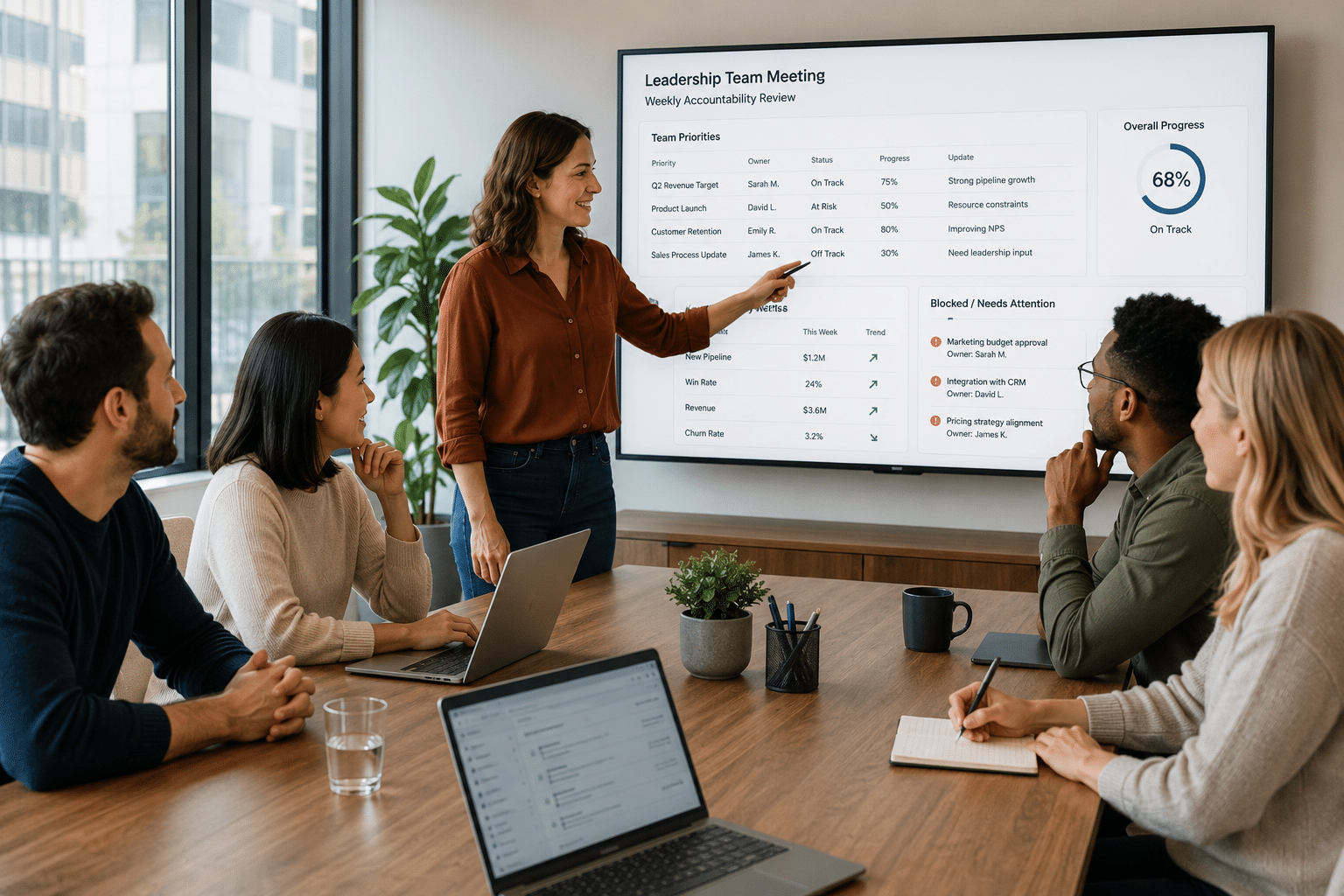
Every Huddle meeting runs on the same structured agenda. Each team member comes to the meeting with updates ready. What’s going well, what KPIs are trending in the right direction, what priorities are in progress, and what risks or issues need the group’s attention. There’s no improvisation, no agenda that shifts based on who prepped and who didn’t.
KPIs and quarterly priorities are visible in the meeting itself. Align’s Huddle pulls the data from the team’s KPI cards and priority boards directly into the meeting view. There’s no switching tabs to check a dashboard. The team looks at current numbers together, not a snapshot from last month.
Owners are named, not implied. When a risk surfaces, the Huddle captures who owns it and what the next step is. When a priority is flagged as at risk, there’s a named owner to check in with. That single change — moving from collective concern to named ownership — is where most teams start to see follow-through improve.
The meeting stays connected to quarterly execution. Because Align links the Huddle directly to the team’s quarterly goals (priorities, OKRs, etc.) every check-in surfaces progress against goals that actually matter to where the company wants to go. The team spends less time talking about process and more time making decisions about what needs to move.
For a real-world example of what this looks like at scale: MaxHome, a home improvement company using Align, reduced contract cancellations by 30% after building weekly accountability rhythms into their leadership meetings. Visibility into what was happening week-to-week gave the team enough lead time to intervene before problems became results.
Choosing the Right Tool for Your Team
When evaluating team meeting software for accountability, run each option through these questions:
- Does it give the team a repeatable agenda format they’ll actually follow? If building the agenda is work, the team will default to improvising.
- Does it pull live KPI and goal data into the meeting itself? If data lives elsewhere, the meeting becomes disconnected from what it’s supposed to track.
- Does it capture named owners on open items? If not, follow-through will stay optional.
- Does it stay connected to the company’s quarterly priorities? If meetings aren’t linked to execution, you’re optimizing coordination, not results.
- Does it give leaders visibility between meetings, not just during them? Real accountability lives in the days between meetings, not the hour of the meeting itself.
Your Meeting Cadence Is Already Costing You
Your team is already meeting every week. The question is whether those meetings are producing accountability or just producing more meetings.
71% of senior managers say their meetings are unproductive. More than half of employees leave without knowing what they’re supposed to do next. If that sounds familiar, the fix isn’t fewer meetings, it’s a different meeting system.
A leadership team that runs a structured weekly Huddle — with consistent agendas, named owners, live KPI visibility, and a direct connection to quarterly goals — doesn’t need a follow-up meeting to find out whether last week’s action items got done. They already know.
See how Align’s Huddle feature supports weekly leadership accountability — and what that rhythm looks like in practice: aligntoday.com/product/huddle-tools
Or if you want to understand exactly how much untracked execution is costing your team right now, start with the Misalignment Cost Calculator — it runs the math in under two minutes.
Smart Moves Today. Big Wins Tomorrow.
Align is strategic execution software for leadership teams who want plans to turn into results. More than 2,200 companies across 64 countries use Align to build consistent execution habits, run effective weekly meetings, and keep teams accountable quarter after quarter. Learn more at aligntoday.com.