The Four Places Organizational Misalignment Hides — And What It’s Costing You
Your business feels harder to run than it should.
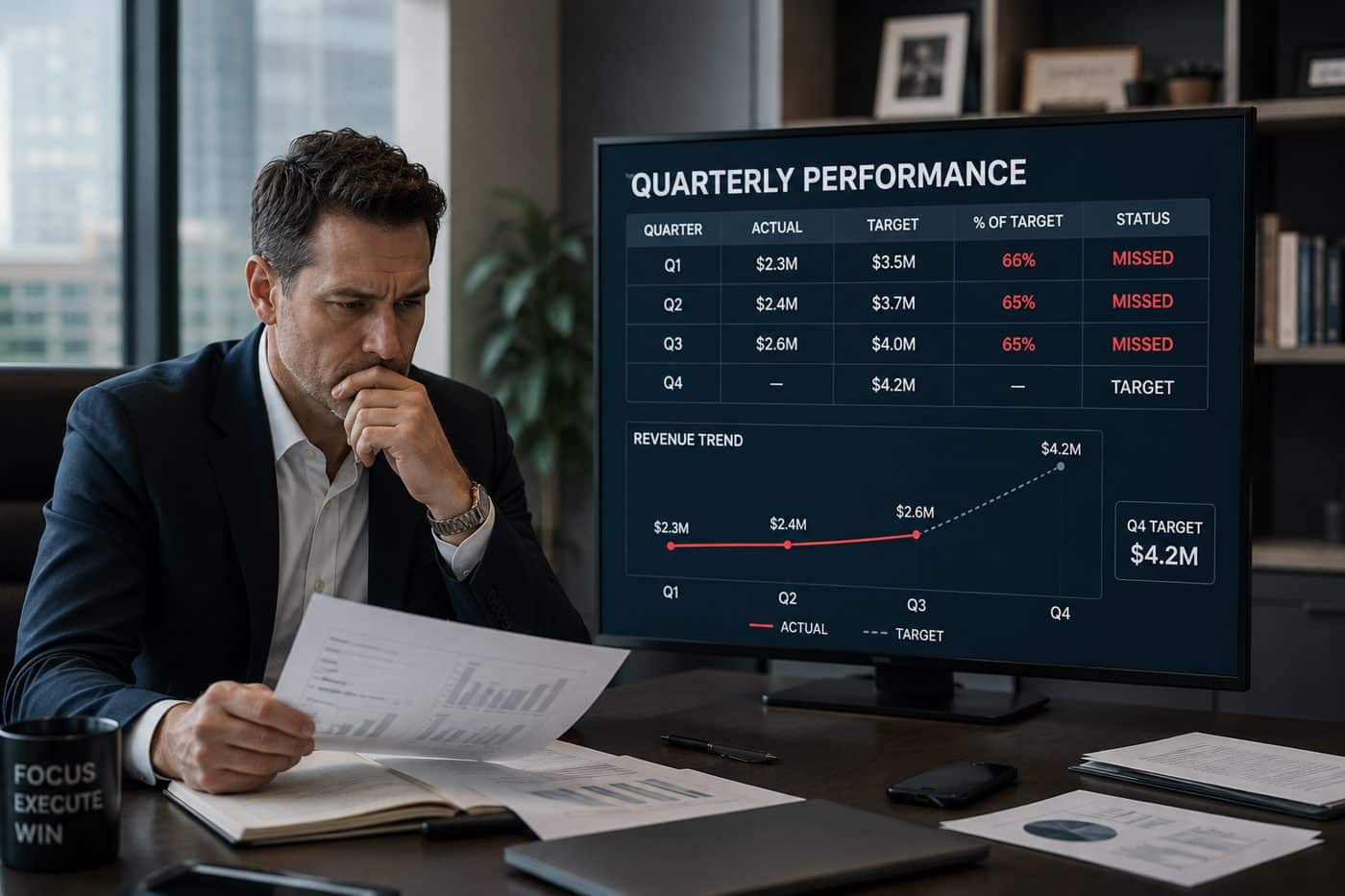
The team is capable. The strategy is clear on paper. The effort is visible in every meeting. And yet the quarterly results keep landing short. Before you hire another consultant or add another reporting layer, consider this: the gap between your strategy and your results likely has a name. It’s organizational misalignment, and most leadership teams can’t see it because it hides inside effort, not absence.
The four places it hides are measurable. So is the cost.
Why Most CEOs Don’t Recognize Misalignment
Misalignment rarely announces itself. It shows up as a capable team that keeps missing the mark by a little — enough to frustrate, not enough to trigger a full investigation. That’s exactly what makes it so expensive.
A Harvard Business Review analysis of more than 500 employees found that actual strategic alignment was two to three times lower than what executives perceived it to be. Leaders leave the strategy meeting confident that everyone is on the same page. The team leaves and executes against their own interpretation. Once that gap opens, the cost spreads across the business in ways that make each symptom look isolated.
Payroll looks fine. Leadership looks busy. The strategy deck looks solid. But the four cost centers below are compounding every quarter.
Here’s where to look.
Cost #1: Payroll Spent on the Wrong Goals
Your team is working at full capacity. The question is whether that capacity points toward the right targets.
When strategic goals aren’t explicitly connected to daily work, people stay busy without advancing the strategy. Project updates keep coming. Status reports look healthy. But a meaningful share of effort goes toward work that isn’t tied to what matters most this quarter. Individual contributors stay active, and no one flags the disconnect until the quarterly review confirms the miss.
The math on this gets uncomfortable fast. For a company with 50 employees at an average salary of $75,000, a 15% misdirection rate represents more than $562,000 in annual payroll costs, yielding no strategic return. Larger teams, higher average salaries, and higher misdirection rates compound that number quickly.
The exact figure varies by business. The cost is never zero.
Cost #2: Leadership Hours Spent Managing Escalations Instead of Growth
Senior leaders are the most expensive resource on your org chart. When strategic alignment breaks down, that resource gets consumed by work that should never reach the executive level.
Decisions that belong with the team closest to the work get pushed upward because those people lack the context to make them. Department conflicts land on the CEO’s calendar because no shared priority framework exists to resolve them. Questions about what matters most this quarter get answered in one-on-ones rather than being visible to the full leadership team.
Bain’s Michael Mankins, Chris Brahm, and Greg Caimi documented in Harvard Business Review that a single recurring executive committee meeting consumed more than 300,000 hours of organizational time annually, including preparation and downstream meetings. The issue was not the meeting itself. It was the absence of shared strategic priorities that made the meeting necessary in the first place. The equation holds for companies of any size: every hour your leadership team spends managing misalignment is an hour not spent on growth.
The signals to watch for:
- Decisions that should be made at the team level showing up in your 1:1s
- Department heads seeking executive sign-off on priorities already set in the annual plan
- Weekly leadership meetings focused on status updates rather than strategic decisions
- Recurring conflicts between teams that share ownership of the same goals
Cost #3: Revenue Lost to Strategic Goals That Are Never Achieved
A goal doesn’t have to be completely abandoned to become a missed target. It only has to miss period after period to still have a costly impact.
An initiative that reaches 60% completion before losing momentum doesn’t translate into 60% of its value. For most strategic goals, the return concentrates at completion: the client contract closed, the operational improvement fully implemented, the new market entry launched. Partial execution yields a partial return (often none) on the time already invested.
CEOs recognize this pattern from experience. What’s harder to quantify is the dollar value of each stalled goal in foregone revenue, delayed cost savings, or strategic momentum that had to be rebuilt the following quarter. When multiple goals stall in the same year, the compounding effect on performance over the next 18 months is significant, even when no single missed deadline looks large in isolation.
Stalled execution has a structure. It starts with unclear ownership, worsens when accountability rhythms break down between quarterly reviews, and becomes a pattern when the organization lacks real-time visibility into which goals are moving and which are at risk.
Cost #4: High-Performing Talent Leaving for a Preventable Reason
Most leadership teams model turnover costs carefully. Replacement expenses, ramp time, institutional knowledge loss — these get factored into workforce planning. What those models rarely isolate is how much of the turnover was driven by misalignment rather than compensation.
Employees who can’t connect their work to a clear strategic direction disengage long before they resign. By the time the exit interview happens, the real cost has been compounding for months.
Research by Boushey and Glynn for the Center for American Progress found replacement costs ranging from 21% of annual salary for frontline roles to more than 213% for senior and specialized positions. Those figures get absorbed into turnover budgets without questioning the root cause. When a high-performing manager leaves because the company lacks direction, that departure appears to be a retention problem.
The misalignment that caused it stays invisible.
Why These Four Costs Multiply — And How to Calculate Yours
Each cost center is expensive on its own. What makes misalignment structurally damaging is the way the four reinforce one another.
When goals aren’t clear and connected to individual work, effort gets misdirected. Misdirected effort creates ambiguity that travels up the organization. That ambiguity consumes leadership time, which means less strategic clarity flows back down. With less direction, fewer goals get finished. The organization that feels unclear and undirected becomes the one most likely to lose the people with other options.
The total isn’t four separate line items. It’s one structural problem generating compound cost across four parts of the business simultaneously.
A quick diagnostic: how many of these apply to your organization right now?
- Quarterly goals exist, but ownership isn’t single-threaded
- Leadership spends time in meetings answering questions the strategy should already answer
- Strategic goals from last year are still marked “in progress”
- High performers have cited lack of direction or clarity in exit conversations
- Your team is busy, but you can’t confirm that busyness connects to this quarter’s targets
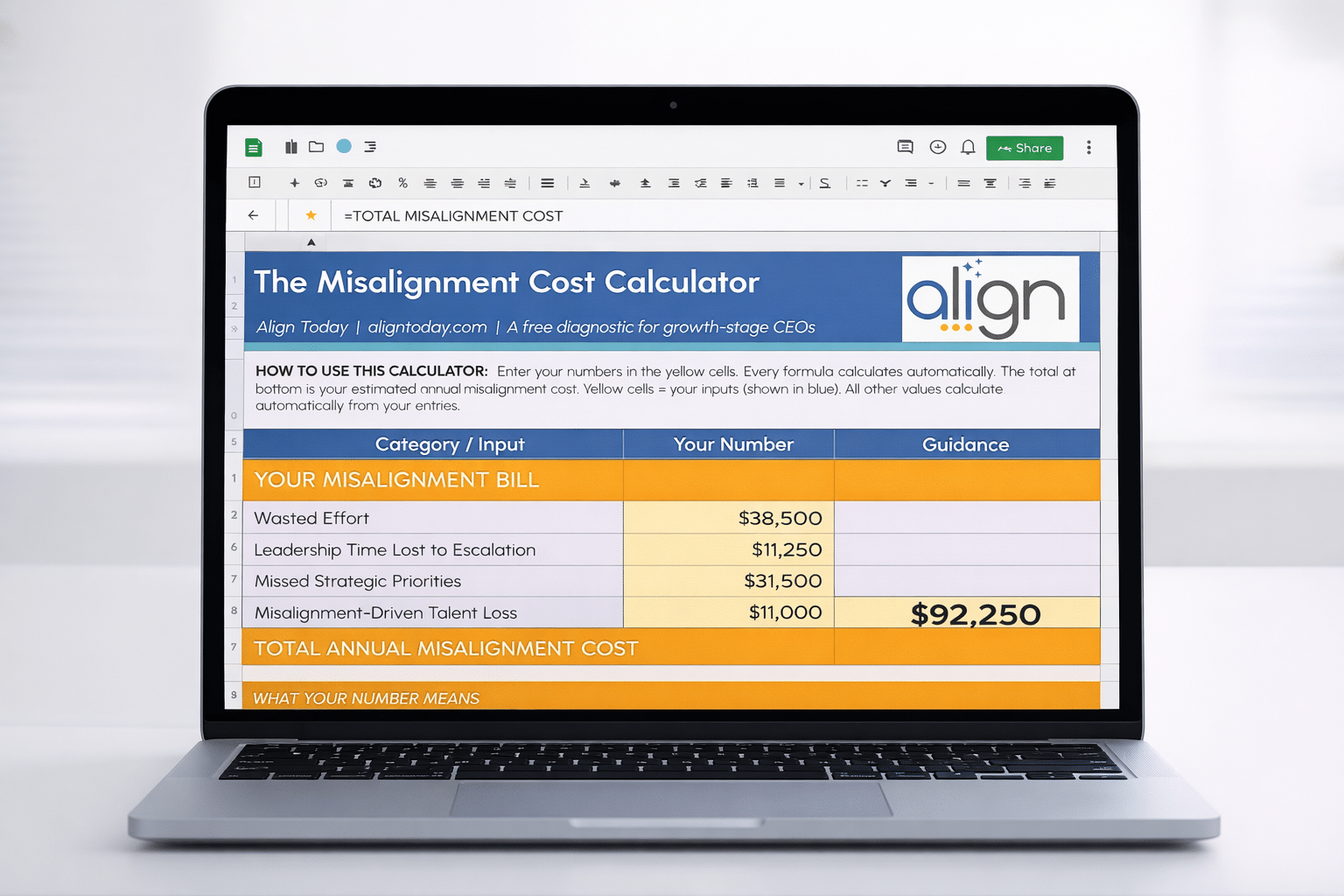
If three or more of these land, the cost of misalignment in your organization is already material. The Misalignment Cost Calculator gives you a specific number — built from your headcount, average salary, and execution rate — so the business case for fixing it stops being abstract.
Calculate your misalignment cost
What Alignment Produces for Growth-Focused Leadership Teams
When strategic execution tightens, all four costs shrink at once.
Effort concentrates on the work that moves the strategy. Leadership time shifts from managing escalations to making the decisions only leadership can make. Strategic goals finish at a higher rate because ownership is clear and visibility keeps them moving between quarterly reviews. People who understand where they fit — and what their contribution actually produces — stay longer and perform better while they’re there.
The business stops feeling harder to run than it should.
Align closes the gap between where your strategy lives and where execution actually happens. Goals are visible and owned. KPIs update weekly. Accountability rhythms keep every quarter connected to the annual plan. The four cost centers don’t require four separate solutions — they share one root cause, and they respond to one structural fix.
Know your number. Then build the system that changes it. → Calculate your misalignment cost
Smart moves today. Big wins tomorrow.