
3 Weekly Leadership Habits That Build Accountability Into Your Execution System
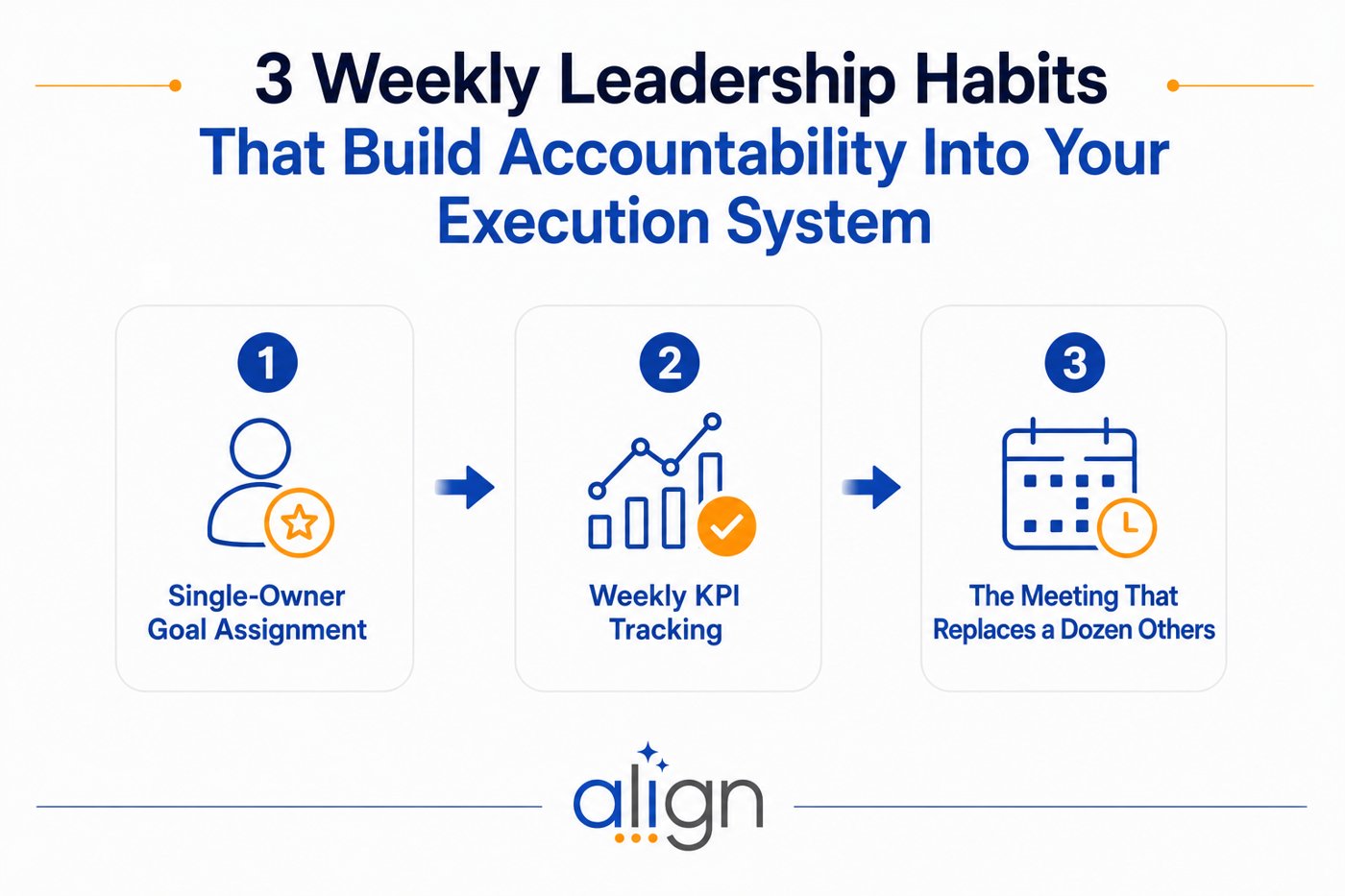
Building a culture of accountability in your organization starts with three weekly leadership habits — and most growth-stage companies are missing at least one.
How many can relate to this scenario?
You’re sitting in the quarterly review meeting, and your CEO asks why the revenue growth target was missed.
The room goes quiet.
You all glance at each other, waiting for someone to take the lead on the explanation. Eventually, someone speaks up. The account they give is accurate enough, but it’s incomplete, and feels like a list of excuses. (It’s also too late to change anything.)
That moment has very little to do with who is in the room. The leadership team is very capable. The initiative is correct at a high level. What’s missing is the structure that would have surfaced the drift in week four rather than in week thirteen.
Accountability isn’t about effort or having someone to blame. It’s about setting up a mechanism that enforces it naturally. That structure is built on three habits, each reinforcing the others and mitigating the risk of breakdown.
Habit 1: Single-Owner Goal Assignment
Shared ownership is the biggest reason for stalled goals.
When two or three people share accountability for an outcome, each assumes the others will drive it, and the goal goes idle.
To avoid this, start by breaking annual goals into actionable quarterly priorities. Then assign one person to be responsible for the outcome, the weekly status, and the result at quarter close. That person doesn’t have to do all the work, but they are the one who monitors for drift, escalates the blocker, and stands behind the number at the quarterly review. Read more: How to Turn Annual Goals Into Quarterly Execution
When specific ownership is assigned to each leader, accountability becomes self-reinforcing because no one wants to be the person whose priority is perpetually yellow. It creates pressure that doesn’t require the CEO to apply it.
The Priority habit also changes how quarterly planning works. When every initiative enters the quarter with a named owner and a weekly status cadence already attached, the planning meeting becomes operational.
Habit 2: Weekly KPI Tracking — What Gets Seen Weekly Gets Managed
Your leadership team has KPIs. That’s not unique. What sets apart teams that execute from those who stall is how often those numbers are actually seen, and by whom.
A KPI reviewed at month-end or quarter-end is a reporting tool. It confirms what occurred in a period that’s already closed. A KPI tracked weekly — tied to a named owner, visible to the full leadership team — becomes a signal. It tells you whether the metric is moving in the right direction before the month closes, so there’s still time to course-correct.
The shift sounds minor, but in practice, it changes what your leadership team talks about. Instead of monthly reviews that produce explanations, weekly check-ins produce course corrections.
By making numbers visible to the whole team, you’ll further enhance the culture of accountability.
Here’s what the Numbers habit requires in practice:
- Every priority owner from Habit #1 has at least one KPI that measures the progress of that priority.
- Status is updated weekly, not at month-end
- The full leadership team sees it without scheduling a meeting to find out where things stand
- Any metric trending yellow gets flagged before it turns red, and actions are taken to move closer to green.
When numbers are visible weekly, the people closest to the work stop waiting to be asked. They adjust before the conversation is necessary. That shift — from reactive reporting to active management — is where the Numbers habit earns its place.
Habit 3: The Meeting That Replaces a Dozen Others
Leaders’ calendars are full of meetings that exist because people don’t know where things stand. Update calls, check-ins, status syncs — each one is a symptom of an organization that doesn’t have a weekly structure to tackle this.
The weekly leadership huddle provides that structure. Brief, structured, and consistent, it’s where priority status gets updated, potential KPI issues surface, and blockers get raised before they become the reason a quarter came in short.
Done well, the huddle doesn’t add time to your leadership team’s week. It reclaims it. When every leader knows the weekly moment is coming, the side conversations, ad hoc check-ins, and escalation emails start to decrease on their own.
What belongs in the huddle:
- Quick goal status by owner
- KPI flags from the week
- Any blocker that needs a leadership decision
- Actions required to move the goal closer to the target
What doesn’t belong in it: problem-solving, project task updates, or anything that belongs in a working session. The huddle is a signal-sharing meeting, not a working one. Keep it under 30 minutes. Run it at the same time every week. The consistency is the main point. Read more: How to Run a Better Weekly Leadership Huddle
After a quarter of running it well, the huddle becomes the mechanism through which accountability operates and drives real outcomes.
The gaps in these habits have a dollar value. The Misalignment Cost Calculator estimates the financial impact — across payroll, leadership time, and initiative underperformance — using your own numbers. Once you see it, you can fix it.
How the Three Habits Compound
When you run all three habits together, something different happens.
The Numbers habit gives your leadership team the weekly signal. The Huddle habit gives them the weekly moment to act on it. The Priority habit makes sure there’s always one person ready to own the action. Each habit reinforces the others, and the whole system gets stronger every quarter it runs.
After one quarter, your team arrives at the huddle prepared, having already reviewed and updated the numbers. After two quarters, priority owners surface drift earlier. After three quarters, accountability becomes the way the organization operates.
That’s the compounding effect. Reporting confirms what happened. Habits change what happens next.
MaxHome, a home remodeling company that scaled from 50 to 130 employees over five years, is a straightforward example of what this looks like in practice. Before building a weekly execution structure, CEO Larry Closs described a familiar pattern: “We would ignore the priorities set in planning meetings.” Once the Numbers, Huddle, and Priority habits were running consistently, that changed. Closs no longer needed to call his managers constantly to check in. “I just spend a few minutes in the morning and I know exactly what my employees are working toward.” The result: a 30% reduction in contract cancellations was a direct financial outcome of accountability becoming a weekly operating discipline rather than a leadership intervention.
The habits didn’t change MaxHome’s strategy. They promoted a culture of accountability.
Where to Start
You can hire your way to more capacity. You can spend your way to better tools. But the structure that makes accountability automatic has to be built — and it starts with a decision to run these three habits consistently, every week, with named owners and visible status.
Start with the ownership habit — it’s the most foundational of the three. Assign a single owner to each of your five most important quarterly priorities and commit to reviewing their status as a team every week for one full quarter. The Numbers and Huddle habits follow naturally once the team has clear ownership and a weekly moment to act on it.
For detailed guidance on how to turn each habit into a self-running execution rhythm, enroll in the FREE 5-day Execution Blueprint.
The Execution Blueprint: How to Close Your Execution Gap walks growth-stage leadership teams through the exact structure behind the Numbers, Huddle, and Priority habits — so the system runs without you being the engine every week.
Get Access to the Execution Blueprint →
Smart Moves Today. Big Wins Tomorrow.
Align is strategic execution software for leadership teams that want plans to turn into results. More than 2,200 companies and 16,000 users across 64 countries use Align to build better habits, stronger alignment, and predictable growth. Book a personalized tour →